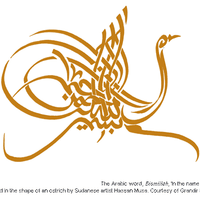
Peacemaking and Peacemakers in the Great Reading
-
And I can only wonder when this meaning was altered..
But the sad reality of life is that there will always be the conquerors and thieves, and one must defend oneself to flourish.Peace Ths,
Good question; when did the meaning get distorted? Because the language of the great reading was perfectly clear , it wouldn't make any sense for an aggressive army to invade and occupy lands calling themselves "peacemakers" (muslimun).
2278 He named you peacemakers before and in this.
320 So, if they argue with you then say, "I have made peace with my whole being for the god, as have those who follow me." And say to those who got the book and the commoners, "Would you make peace?"The aggressive force could not call themselves peacemakers. This is proven by archaeological evidence; a papyrus datable to 644CE refers to an "emigration" (higra) and Christian sources of the period frequently call the Arabs "emigrants" (muhagirun) not "peacemakers" (muslimun). See Robert G. Hoyland, Seeing Islam as Others Saw It A Survey and Evaluation of Christian, Jewish and Zoroastrian Writings on Early Islam, Studies in Late Antiquity and Early Islam, 13 (Princeton, N.J. Darwin Press, 1997). Pp. 890
So, "islam" (peacemaking) was wrongfully equated to "istislam li-allah" (surrendering to the god) sometime later on, probably to allow continued warmongering and imperialism under the banner of the expanding "Islamic Empire" (Peacemaking Empire... ;D).
Indeed, as you said, there is aggression in this world and it must be fought. Peace doesn't happen naturally, even from the very start (527 +), so we must be peacemakers. Ironically, just after starting this thread (based on Dr. Ayman's original findings) I watched the movie "Hotel Rawanda" and the UN forces used the flimsy cop-out, "We're here as peace-keepers, not peace-makers". We have to make peace in this world, may the god give us victory.
Peace,
-David
-
But the god commands us to jihad even though we may not like it.
In the international media we increasingly hear many untranslated Arabic words. Examples include words such as Islam, Muslims, Islamist, Jihad, Alqaida, etc... By taking such words as proper names or meaningless labels, those who spread corruption in the earth have been able to attach whatever meanings they want to those words. Both Arabic and non-Arabic speakers have been deceived by such tactics.
For example, when the word Jihad is mentioned, the first image that is evoked in the minds of the majority of Arabic and non-Arabic speakers is that of a religious holy war. This meaning has taken hold despite the fact that all Arabic dictionaries say that the word "jihad" simply means "striving". Of course, "striving" is a positive word that doesn't carry violent connotations in the minds of the audience. Being Arabic speakers has not helped people avoid this trap because the proper name blocks the true meaning of a word even in Arabic.
As we have seen, by transforming a word into a proper name, a new meaning has been attached to a neutral or positive word. This phenomenon has worked both ways and thus we also see Arabic words with a negative meaning being used as proper names whose inventors have intended as positive.
For example, ironically the opposite of those who strive ("al-mujahidun" in the great reading is the idle ("al-qaidun" according to passages such as 495. Those who lied to the god and his messenger are said to have been idle ("qaid" in 990. Generally the word "qaid" in the great reading has the meaning of "stop/idle/hinder". Thus, the "qawaid" are what stops a building from falling (2127, 1626) and "qawaid" are also women who stopped desiring marriage (2460). We also hear about the descendents of Israel who disobeyed Moses as being idle ("qaidun" in 524. Even the devil himself is described as hindering ("qaid" humans from the straight path of the god (716). In Arabic, the feminine form has the same meaning as the masculine form but adds intensification. So in the context of striving, "al-qaida" actually is the opposite of the true striving and it means "the intensely idle/the intensely hindering".
Whoever chose the name Alqaida for an outfit that we often hear about on the news as a symbol of "extreme Islamic Jihad", must be completely clueless about the great reading and Classical Arabic. Whoever chose that name was certainly hopelessly ignorant of the connotation of the word in the great reading and the fact that it actually means the opposite of striving ("jihad". Indeed, they scheme and scheme but the god is the best schemer. The god's message continues to be a witness against those who claim to strive for the god in order to commit corruption in the earth.
How do we strive for the god his true striving? The answer is given in 2278
- And strive for the god his true striving. He has brought you and has made no hardship on you in the obligation, the creed of your father Ibrahim. He (the god) named you the peaceful ("al-muslimeen" before and in this, so that the messenger will be a witness against you and you will be witnesses against humankind. Thus, persist in the learning connection and bring betterment and hold to the god. He is your protector, a most excellent protector and most excellent supporter.
We strive for the god his true striving by continuing to learn and teach others about his message, bringing betterment as opposed to corruption in the earth, and holding on to him.
This is not really a conclusion but is a humble step forward in a long journey. It is a step for restoring the true meaning of the striving for the god. We can start by teaching people about the real meaning that was blocked by the proper names. When such barriers are removed, the world will be a better place. Suddenly, "extreme peaceful striving" doesn't sound so bad.
Only thing is that "peaceful" should be "peacemakers". )
-
Peace to David and everyone here
Sulaiman was organizing his army/troop/force which was no peace keeping force as it refers in every use of this word (junod) in the Quran. Sulaiman is a disciplined general and to most his threat to the hoopoe for being absent from the formation with ?torture/punishment or death" will qualify Sulaiman to ruthlessness rather than peacefulness. The queen did not send a bribe or a Trojan horse neither did she wrap herself in a carpet and deliver herself as Cleopatra. She sent him a gift. It?s clear from the Quran there is no hidden agenda. But even if we need to twist it as a bribe let?s ask the simple question, ?what for was the bribe ? " . Simply to protect her kingdom from Sulaimans forces because look at the threat he delivers.. Fortunately, God made her march to him, but imagine what would have happened if she did not go to Sulaiman. Put this whole story in today?s context, imagine the president of USA or for that matter any country doing this to his less powerful neighbor. Do you think Sulaiman qualifies for the Noble PEACE prize for being so peaceful? Let?s not build our own excuses or conspiracy theories to justify Sulaiman?s actions because we need to arrive at a forced meaning for the word ?Islam?.
Sulaiman is a Messenger and has to submit to Gods command and had to deliver the message he was sent with. I believe some of Gods messengers received instructions from God to fight a nation if they do not fall to the will of God, willingly. This is the same in the Torah. When Moses and the Children of Israel come to the Promised Land the people living there already were not hurting Moses or the Children of Israel and they were no threat. But Gods command has come to take the land from them with force. But did you notice what the ?peaceful ones? said. ?Let them leave, then we will enter". But what did the believing ones said? ?Attack?. Which of the two is the better submitter?
Simple as it sounds I noticed grammarians stayed away from this meaning of peacemaker. I probably agree with Ayman that there is a common thread of peace running in all the forms of this root. Maybe it is peaceful resignation or peaceful submission as highlighted in Ramzan Zuberi?s article in the link I provided earlier. Or we may not have the exact word in English which brings out the meaning ?peace? and ?submission? together as the usage of this root represents in the Quran.
-
This is the same in the Torah. When Moses and the Children of Israel come to the Promised Land the people living there already were not hurting Moses or the Children of Israel and they were no threat. But Gods command has come to take the land from them with force. But did you notice what the ?peaceful ones? said. ?Let them leave, then we will enter". But what did the believing ones said? ?Attack?. Which of the two is the better submitter?
Peace Warner,
Leaving aside for a moment that horrid image of Solomon, which I already addressed by recalling the righteous armies of Taloot and David (Solomon's forerunners), let's take a look at the truthful history of Moses and the land.
523 Two men of those who feared and were blessed by the god said, "Enter on them using the gate."
Traditionalists see this entering as an attack, which is clearly negated by 1269.
1269 When they entered on Joseph.
His brothers didn't attack him! Back to Moses, the unrighteous were the only ones who said ANYTHING about fighting! Reminds me of the Zionists, honestly...
524 They said, "Yo Moses, we will never enter it as long as they are in it - so you and lord go and fight, we will stay right here!"
Who said anything about fighting? Read it all in context. It's really funny - they basically come out of nowhere and start making assault plans. Don't use the Bible to say that a righteous army killed thousands of men, women and children just because they weren't bani Israel.
You see aggression and warmongering where there is none - absolutely none. It's no wonder you disgrace Solomon as such. The great reading, however, maintains his honor as a peacemaker and a righteous military leader. As for the "dhibh" regarding "hadhad", did you ever consider that it might not refer to slaughter? See http//free-minds.org/forum/index.php?topic=13069.msg233662#msg233662 The basic meaning of "sacrifice" is to give something up, not to open something's throat.
Did you know that white Europeans thought they were doing the god's work by enslaving African pagans? Do you really think that the god used to make armies to go and kill people for not serving the god? What kind of god is this? Allah al-salam = the god is peace.
Peace,
-David
-
Salaam David,
Is there an article, on this topic specifically, online that you are aware of? And if not, is there a way we could get this information posted in the articles section?
The reason I ask is because I think that this is a topic of incredible importance, and not just etymological significance.
I was discussing an article online on 'Anarca-Islam', and it was getting bashed immediately by everyone. Mostly because anarchists tend to also be against organized religion, but also several people responded that since Islam means 'submission' it is directly antithetical to anarchism. And it's quite hard to convince people that Islam means peace if every source online states that it means submission.
My interest in anarchism started by my idolizing of Noam Chomsky, whom you've most probably read if you're familiar with Norman Finkelstein. So I've been researching more into it recently, and am as of yet undecided on it, but definitely do not agree that it goes against the principles of Islam.
Anyway a simple article reflecting the etymological arguments is needed. I've gone over brother Ayman's article on Peacemaking, and find that it lacks the etymological argument, which I think is strongest.
-
Salaam David,
Is there an article, on this topic specifically, online that you are aware of? And if not, is there a way we could get this information posted in the articles section?Peace Ths,
In truth, my post was the result of a discussion I had with Dr. Ayman about his articles. I was working on a possible website where I had used "peacefulness" for "islam" and "peaceful" for "muslimun", but he told me that his latest research had concluded that the MAKING of peace is a far better and more meaningful translation. After searching on the forum I saw the etymological evidence myself and also found the evidence overwhelming.
Perhaps Ayman would re-write and refine his article in the articles section. I would love that. We do need to get cracking in both islam (peacemaking) and islah (fixing). This world is broken, it's inhabitants are starved to death by the greed of empires and subject to endless imperial bloodletting and extreme brutality. I really hope the message of peacemaking will become universal, which might be the best way to look at this passage
933 He is the one who sent his messenger with guidance and the true obligation , to make it expose/overtake all other obligations, in spite of the idolaters.
So while they're busy arguing this and that (re Muhammad, Ali, Hassan, Hussayn, Hadith, Sunnah, etc.), sipping tea and coffee and eating sweets, others will be out there trying to make a real difference. For example, I just got an e-mail in my inbox from Yuksel talking about peacemaking. While I admire that message, I wonder how devoted he is when he spends so much time chasing 19 "miracles" and defending a liar like Rashad Khalifa. How much of a peacemaker was Khalifa, constantly bashing "the Arabs" - a group that's been kept down by a long line of tyrannical leaders with Western backing, not to mention an unholy assault by US and Israeli thugs, vandals and marauders.
PEACE ,
-David R. S. Aitken
-
Peace. Follow-up here http//free-minds.org/forum/index.php?topic=9600545.0
-David
-
Hi all,
can someone explain the following
in arabic grammar, everyone seem to say ISLAM come from verb ASLAMA 4th form, aslama means "to give up", "to surrender" then ISLAM is masdar and means submission.
BUT
When I look to the verb forms I see
1
2
or 34
5
6
7
8- 9
10
masdar form 4 of root FA3ALA is IF3AAL,
if I replace FA3ALA by SALAMA I get ISLAAM
so islam is the masdar of the 4th form of root SIN-LAM-MIMis it correct or am I wrong????????? Please help!!!
- 9
-
Peace Herbman,
can someone explain the following
in arabic grammar, everyone seem to say ISLAM come from verb ASLAMA 4th form, aslama means "to give up", "to surrender" then ISLAM is masdar and means submission.
BUT
When I look to the verb forms I see1
2
or 3
4
5
6
7
8- 9
10
masdar form 4 of root FA3ALA is IF3AAL,
if I replace FA3ALA by SALAMA I get ISLAAM
so islam is the masdar of the 4th form of root SIN-LAM-MIM
is it correct or am I wrong????????? Please help!!!
You are correct that ISLAM is the 4th form of the root SLM. However, you are wrong that ASLaMa means "to give up" or "to surrender".
You have wrongly assigned a meaning associated with the 2nd form to the 4th form.
The 2nd form whose verb takes a Shadda on the letter "3in" as in verb form Fa33aL has a Masdar of TaF3IL and not IF3AL.
2
Examples of this include
and
and
in Mazhar's example (notice the Shadda on the letter "Lam", which doesn't exist in /MuSLiM)The fourth form ASLaM, ISLAM relationship with SaLAM (peace) is that SaLAM (peace) is the "name of its Masdar". The only reason grammarians call SaLAM the "name of its Masdar" and not its "Masdar" is that it has less number of letters than the verb (it is missing the initial Alif).
Here are some examples
Masdar
Name of Masdar
Masdar
Name of Masdar
By the same token, Masdar
Name of Masdar
Here is the grammarians? definition of the Name of the Masdar
It is what EQUATES the Masdar in the indication of the outcome
So by definition, the Masdar ISLAM indicates the outcome as the Name of the Masdar SaLAM (peace). So the outcome of ISLAM is SaLAM (peace). In other words, apart from cultural and religious biases, purely from a linguistic point of view according to the rules of grammar ISLAM literally means peacemaking.
Peace,
Ayman
- 9
-
The fourth form ASLaM, ISLAM relationship with SaLAM (peace) is that SaLAM (peace) is the "name of its Masdar". The only reason grammarians call SaLAM the "name of its Masdar" and not its "Masdar" is that it has less number of letters than the verb (it is missing the initial Alif).
There seems some confusion.
is the Verbal noun of -
while is verbal noun on pattern -Form-IV. Verbs -
purely from a linguistic point of view according to the rules of grammar ISLAM literally means peacemaking.
Who can accept this?
-
There seems some confusion.
is the Verbal noun of -
while is verbal noun on pattern -Form-IV. Verbs -The confusion seems to be the ignorance of the difference between Masdar and Name of Masdar. The Masdar of form II (TaSLIM) has the meaning of surrendering/giving in. Confusion is to want to instead apply this meaning to forms IV and/or I. When "salam" is used with Form IV it is the Name of the Masdar as in .
Also, both AND are the verbal nouns of - and not just . In this case, they both have the same meaning of "being whole/intact/free of harm" and not the meaning of "peace".
Who can accept this?
Let?s see
whoever surrendered his face to Allah ? doesn?t make much sense and form II / should be used to better give this meaning.
whoever made his direction peaceful to/for the god ? makes sense and applies the standard form IV meaning.Peace,
Ayman
-
Peace to all,
Thanks Mazhar, Ayman and someone.
Yes it is (was) quiet confuse and still need to re-read everything to put every thing in place.
Your help is really appreciated.
Thanks
I post this table for future reference
Based on this table,
|
| 1 -
| 2
| 3 or
| 4
| 5
| 6
| 7
| 8
| - 9
| 10
-
The confusion seems to be the ignorance of the difference between Masdar and Name of Masdar. The Masdar of form II (TaSLIM) has the meaning of surrendering/giving in. Confusion is to want to instead apply this meaning to forms IV and/or I. When "salam" is used with Form IV it is the Name of the Masdar as in .
Also, both AND are the verbal nouns of - and not just . In this case, they both have the same meaning of "being whole/intact/free of harm" and not the meaning of "peace".
Let?s see
whoever surrendered his face to Allah ? doesn?t make much sense and form II / should be used to better give this meaning.
whoever made his direction peaceful to/for the god ? makes sense and applies the standard form IV meaning.Peace,
Ayman
A deliberate journey from simple confusion to compunded confusion merely to adhere to the thought once conceived.