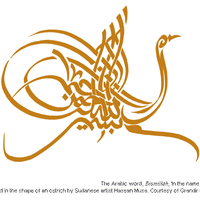
Peacemaking and Peacemakers in the Great Reading
-
-
I prefer a better interpretation of the word 'serve' NOT 'subservience/allegiance' in your quote of 5156. Serving God doesn't still prove to me its a master slave relationship between us and God. The very freedom of choices we have as humans is more strong empirical evidence for me that we are not slaves to God.
I guess it comes down to how we both interpret the word slave in english. I guess in one meaning of the word we are slaves of God as we are His property but we do have the freedom He has bestowed on us to follow whatever path.
I agree with you, all depends on how we interpret the word slave in a way I think we are all submitted indeed, we are all forced to obey Gods laws, (even non-believers) I am thinking on the natural laws for example like gravity law... in other matters we received freedom of choice to obey Him and submit to Him or not. And here something else is playing a role. Even when we submit/obey willingly, in free-choice, what is the intention, what is the motivation of this submission? A slave will simply obey out of fear for punishment or for possible reward, while in other way someone else will obey simply of knowledge that this is the best to do even because of Love for God. In the second possibility I don't think the subject sees himself as a slave!!
Peace.
-
Merely by one omission of these translators Form-II cannot be considered to denote what is signified by form-IV. At all other places of occurrence of Form-II they have translated it as save, protect and salutation, greeting, as I have quoted three examples.
surrender, yield, submit, succumb to, give in. ( طThere is no point in arguing about a fact that every translator and Arabic speaker knows independent of any specific text and is easily verifiable. Go ask any neutral person on this forum or anywhere who knows Arabic how they would translate
- surrendered/gave in his weapon
OR - saved or saluted his weapon
Once you understand the unbiased person answer then you will know that form II definitely has the connotation of surrender and form IV definitely has the connotation of peacemaking.
- surrendered/gave in his weapon
-
Go ask any neutral person on this forum or anywhere who knows Arabic how they would translate
- surrendered/gave in his weapon
OR - saved or saluted his weapon
Where to find a neutral person, more neutral than the writers/compiles of Classical Arabic lexicons. Your problem is the English version of the above sentence since for weapon we have to use in English the word "surrendered" and from there you are not ready to accept all the Arabic lexicons.
The above situation is described in Lane's lexicon also--.
Read page 1412 vol-IV entry 2 and move to page 1413, may be your confusion gets over, Allah willing. - surrendered/gave in his weapon
-
Where to find a neutral person, more neutral than the writers/compiles of Classical Arabic lexicons. Your problem is the English version of the above sentence since for weapon we have to use in English the word "surrendered" and from there you are not ready to accept all the Arabic lexicons.
The above situation is described in Lane's lexicon also--.
Read page 1412 vol-IV entry 2 and move to page 1413, may be your confusion gets over, Allah willing.Yielding is in fact a synonym of giving in/surrendering and not of "save or salute" but maybe you need a neutral English person too to confirm this for you. So the English and Arabic neutral persons will perfectly agree but still the problem is that you did not like it and can't change.
When you find a neutral Arabic person you may also ask them about the difference of form II "massak"/"gave to hold" and form IV "amsak"/"held". In this case too, form II has the giving aspect while Form IV has the aspect of making.
-
I agree with you, all depends on how we interpret the word slave in a way I think we are all submitted indeed, we are all forced to obey Gods laws, (even non-believers) I am thinking on the natural laws for example like gravity law... in other matters we received freedom of choice to obey Him and submit to Him or not. And here something else is playing a role. Even when we submit/obey willingly, in free-choice, what is the intention, what is the motivation of this submission? A slave will simply obey out of fear for punishment or for possible reward, while in other way someone else will obey simply of knowledge that this is the best to do even because of Love for God. In the second possibility I don't think the subject sees himself as a slave!!
Peace.
I agree with your comment I've highlighted also to add.....religions teach fear to serve God and not islam hence why I never see relationship between humans and God as a master slave relationship in the deen of islam.
PEACE
-
Yielding is in fact a synonym of giving in/surrendering and not of "save or salute" but maybe you need a neutral English person too to confirm this for you. So the English and Arabic neutral persons will perfectly agree but still the problem is that you did not like it and can't change.
When you find a neutral Arabic person you may also ask them about the difference of form II "massak"/"gave to hold" and form IV "amsak"/"held". In this case too, form II has the giving aspect while Form IV has the aspect of making.
Yielding
Yielding is a form of social etiquette, with one person allowing access to another person or persons.
In political elections, a losing candidate may yield to the other candidate. This process is known as concession. Preferably this is to be done after the votes are counted.
In traffic, drivers entering a larger road are usually required to yield to cars in the larger road to avoid a fiery collision.
bookmark email print tweet facebook
Computed Synonyms yielding
Rank Intensity Word Synonyms Synonyms of synonym
1 227.0596 yielding yield give in, produce, cede, return, relinquish
2 81.0092 yielding produce yield, make, create, bear, cause
3 70.0092 yielding give yield, donate, render, present, bestow
4 63.0092 yielding compliant docile, pliable, tractable, pliant, obedient
5 58.0093 yielding sell vend, to sell, carry, dispose of, yield
6 58.0093 yielding present gift, offer, introduce, give, current
7 57.0092 yielding flexible pliable, supple, elastic, lithe, versatile
8 55.0091 yielding supple flexible, pliable, pliant, lithe, elastic
9 55.0091 yielding pliable pliant, flexible, supple, lithe, elastic
10 54.0091 yielding soft tender, gentle, mild, limp, sweet
11 54.0091 yielding proffer offer, present, perform, act, play
12 51.3095 yielding giving give, yield, hand over, render, provide
13 50.0091 yielding carry take, bear, to carry, convey, bring
14 49.0093 yielding return go back, turn, returns, yield, bring back
15 49.0092 yielding bear carry, endure, bore, abide, bearing -
Peace all,
just to clarify because arguments are good from both side
from one side we have
FORM II
He made safe; he greeted.
FORM IV
He surrendered, became subservient, allegiant
so, we have
form II means "save" as in 843
form II means salute/greeting as in 2427 see also 2461form IV means "submit"
at the other side we have the opposite meaning
FORM II
He surrendered, became subservient, allegiant
FORM IV
He made safe;
form II whose Masdar is of the pattern is used in 465 to mean surrender.
form II means "surrender" as in 465
465
YUSUFALI But no, by the Lord, they can have no (real) Faith, until they make thee judge in all disputes between them, and find in their souls no resistance against Thy decisions, but accept them with the fullest conviction.
PICKTHAL But nay, by thy Lord, they will not believe (in truth) until they make thee judge of what is in dispute between them and find within themselves no dislike of that which thou decidest, and submit with full submission.
SHAKIR But no! by your Lord! they do not believe (in reality) until they make you a judge of that which has become a matter of disagreement among them, and then do not find any straitness in their hearts as to what you have decided and submit with entire submission.formIV means "to make peace/safe"
From the above I can say one thing
In the example of form II meaning "greeting", it is maybe important to notice the form II is used with the particule 'ala "", I think it is important because a particule can change completly the meaning of a word whatever form he has.
example in english to GIVE and to GIVE UP does not mean the same.
The same can be applied in arabic for exemple with DARABA and DARAB 'ALA.maybe the same apply to Aslamu li e.g. 2112, 2131
could have another meaning with the same form II! Don't you think?
Conclusion, if we remove the salam 'ala and salama li , what remains are the 2 above examples
form II means "surrender" as in 465
vs
form II means "save" as in 843a deeper study with other form II example is therefore needed
sallama vb. (2)
perf. act. 2233, 843
impf. act. 465, 2427
impv. 2461, 3356
n.vb. 465, 3322, 3356
pcple. pass. f. 271, 492, 492
what about axample of form IV
I think more example of form IV can help determining its meaning.
from PRL
perf. act. 2112, 2131, 320, 320, 320, 383, 4125, 544, 614, 2744, 37103, 4914, 4917, 7214
impf. act. 671, 1681, 3122, 4066, 4816
impv. 2131, 2234, 3954
n.vb. 319, 385, 53, 6125, 974, 3922, 4917, 617
pcple. act. 2128, 2128, 2132, 2133, 2136, 352, 364, 367, 380, 384, 3102, 5111, 6163, 7126, 1072, 1084, 1090, 1114, 12101, 152, 1689, 16102, 21108, 2278, 2731, 2738, 2742, 2781, 2791, 2853, 2946, 3053, 3335, 3335, 3912, 4133, 4369, 4615, 5136, 665, 6835, 7214Peace
-
FORM II
He made safe; he greeted.
FORM IV
He surrendered, became subservient, allegiant
at the other side we have the opposite meaning
FORM II
He surrendered, became subservient, allegiant
FORM IV
He made safe;
form II whose Masdar is of the pattern is used in 465 to mean surrender.
form II means "surrender" as in 465
Good effort herbman;
If one accepts this,
He made safe;
then he is suggesting that the act or effect of the verb is moving to someone else. And as such he is declaring this verb of Form-IV as transitive verb; while the fact is that there are very few verbs in Form-IV which are INTRANSITIVE and is one such verb.
One of the meanings associated with Form-IV pattern is that of "finding the subject to have accepted an attribute, or as we say to become something/becomming" referred by the term .
-
then he is suggesting that the act or effect of the verb is moving to someone else. And as such he is declaring this verb of Form-IV as transitive verb; while the fact is that there are very few verbs in Form-IV which are INTRANSITIVE and is one such verb.
Why single out as the excpetion to the clear meaning implied by Form-IV?
Peace,
Ayman
-
Peace to all,
I must admit that I've become more confused than ever before.
First of all, Ayman's argument
FORM II
He surrendered, became subservient, allegiant
FORM IV
He made safe;
Now Mazhar's argument
FORM II
He made safe; he greeted.
FORM IV
He surrendered, became subservient, allegiant
Now Ayman is right when he says means to surrender your weapons in modern Arabic.
This is unequivocally true.Thus, it seems like Form 2 has the connotations of surrender and submission.
However, Mazhar pointed to some very useful verses
843
2427
2461
Now Herbman mentioned that 3alaa changes the meaning, and this is true.
Still, what is curious is that the word for 'greeting' or 'salutation' in 2427 and 2461 are both in Form 2So why is "greeting" in Form 2, something that invokes meanings of submission?
Now as for 843, Asad, Shakir, Arberry, Pickthall, and Yusuf Ali ALL translate it as "God saved you"
There is an argument there that the verse does not mention what exactly God sallamah. It just says "walaakinna allaha sallama"
The next verse reads
When God showed you them in your eyes as few, when you encountered, and made you few in their eyes, that God might determine a matter that was done; and unto God all matters are returned.
Thus, the phrase could mean "but God submitted "
So let us look at Herbman's list more indepth
sallama vb. (2)
perf. act. 2233, 843
impf. act. 465, 2427
impv. 2461, 3356
n.vb. 465, 3322, 3356
pcple. pass. f. 271, 492, 492aslama vb. (4)
perf. act. 2112, 2131, 320, 320, 320, 383, 4125, 544, 614, 2744, 37103, 4914, 4917, 7214
impf. act. 671, 1681, 3122, 4066, 4816
impv. 2131, 2234, 3954
n.vb. 319, 385, 53, 6125, 974, 3922, 4917, 617
pcple. act. 2128, 2128, 2132, 2133, 2136, 352, 364, 367, 380, 384, 3102, 5111, 6163, 7126, 1072, 1084, 1090, 1114, 12101, 152, 1689, 16102, 21108, 2278, 2731, 2738, 2742, 2781, 2791, 2853, 2946, 3053, 3335, 3335, 3912, 4133, 4369, 4615, 5136, 665, 6835, 7214sallama vb. (2)
perf. act. 2233, 843
843 - see explanation above.
2233
Here ALL the main translators have translated sallamtum as "surrendered" or "given", referring either to the child being given to the foster parents, or to the money owed to the foster parents for taking in the child.
It could mean "provided you have made peace with the situation you are in", however, this does not make sense because of the "idha" qualifier.
It says "there is no fault on you IF you sallamtum what you have given equitably.Therefore, according to my interpretation, this example is according to Ayman's argument.
impf. act. 465, 2427
465
I agree with the standard interpretation of this verse yusallimuu tasleeman means submission.
So this also agrees with Ayman's argument.
2427
We addressed this at the top. It definitely means to greet, but it uses form 2 and has the particle 3alaa after the verb.
impv. 2461, 3356
2461
Again, definitely refers to greeting, but also has 3alaa after it.
3356
There may be disagreement about this, but I believe it refers to submission instead of greeting.
n.vb. 465, 3322, 3356
465
Same as above.
3322
All of the main translators translate this as submission.
If we use Ayman's argument here, then this shows without a doubt that there is a heavy connotation of submission within Islam.
I'm inclined to agree here with Mazhar's argument, purely out of ideological reasons, but cannot prove the argument either way.
pcple. pass. f. 271, 492, 492
271
Translated as "without blemish" or some other similar definition.
Therefore the standard interpretation is the same as Mazhar's.
However, it could very well mean "submission" or "surrender", as in "it is a cow, not broken-in, to plough the earth and water the crops in submission"
492
Definitely means to surrender or submit or yield.
Therefore works according to Ayman's argument
492
This is translated as "a believing slave".
This does not make sense. Surely a believing slave would be fadiyatun muslimatun, and not musallamatun?
Therefore I have to interpret this verse as the freeing of a submitted slave, or surrendered slave.
aslama vb. (4)
I shall pick some verses out at random to test.
perf. act. 2112, 2131, 320, 320, 320, 383, 4125, 544, 614, 2744, 37103, 4914, 4917, 7214
Every single one of these verses use aslama as "aslama wajhahu lillaah" or to mean that someone has accepted Islam.
Since this is the very question we want to answer, it is impossible to make any argument on what they mean here. We need instead to confirm or deny that all Form 4 verbs do not imply surrendering so that we can claim that "aslama wajhahu" and other such occurrences definitely do or do not imply surrender or submission.
impf. act. 671, 1681, 3122, 4066, 4816
4816
Can either mean "you fight them or they surrender"
or "you fight them and they make peace"Cannot say which is more correct at the moment.
impv. 2131, 2234, 3954
All occurrences are in the imperative form "Aslim"
n.vb. 319, 385, 53, 6125, 974, 3922, 4917, 617
All occurrences are of "al-Islam"
pcple. act. 2128, 2128, 2132, 2133, 2136, 352, 364, 367, 380, 384, 3102, 5111, 6163, 7126, 1072, 1084, 1090, 1114, 12101, 152, 1689, 16102, 21108, 2278, 2731, 2738, 2742, 2781, 2791, 2853, 2946, 3053, 3335, 3335, 3912, 4133, 4369, 4615, 5136, 665, 6835, 7214
All occurrences are of "Muslim" or its subsidiaries "Muslimoon" or "Muslimeen"
So to summarize what I've discovered.
The Form 2 verbs several times have the connotation of submission or surrendering without a doubt.
There are some verses that could not be proven without a doubt, and in which either interpretation could fit.
But importantly, no verses can be said beyond a doubt to have connotations of peace making or safety.Therefore I'm inclined to believe that Form 2 verbs should always be interpreted with connotations of submission/surrender.
The Form 4 verbs always refer to Islam or Muslims. Therefore it is difficult to make any argument in favor of either stance.
However, we also know that the Form 4 verbs are derived from Salaam, which unequivocally means peace.
salam (peace) ?> aslama (to make peace) ?> muslim (peacemaker)
So to summarize, the perfect example of this confusion amongst the translators is 465 and 4816
465 But no, by the Lord, they can have no (real) Faith, until they make thee judge in all disputes between them, and find in their souls no resistance against Thy decisions, but submit with the fullest submission. (yusallimuu tasleeman)
4816 you fight them or they surrender (yuslimuun)
This is clearly a Form 4 verb, yuslimuun (1 L). Why does it then mean the EXACT same thing as yusallimuu (2 L's) ??
The answer is that it clearly does not mean the same thing. Anyone studying the Quran will know how precise the language is.
We also know that the Form 4 verbs are derived from Salaam (peace), and thus it does not take a rocket scientist to figure out that the Form 4 verbs all mean to "make peace". All references to Islam or Muslims are in Form 4.
The translation should thus read you fight them or they make peaceCoincidentally, I got into this debate last week with a non-Arabic speaking friend, and he argued that I was wrong based on the overwhelming amount of sources online saying that Islam = submission.
He referred to this quote from wikipedia
"The word islam is a verbal noun originating from the triliteral root s-l-m, and is derived from the Arabic verb ??slama, which means "to give up, to desert, to surrender (to God).""
Someone should probably submit a new article to wikipedia, or atleast a paragraph after this stating that aslama itself comes from salaam.
EDIT
Could I ask someone to create a table like Herbman's form table, but with the root of SLM?
I would do it myself but don't consider myself to be knowledgeable enough, although I might try it when I have more time. -
Actually I think it is, and I think that by understanding the grammar first, your understanding of the Quran will deepen.
I've started to create a verb form table for SLM, and I'm ashamed to say that despite growing up in the Middle East, I can't even complete it.
What's more pathetic is that I sent it to an Egyptian friend who enjoys poetry, so his Arabic is better than mine, and he said he didn't know either....so that says something about the standard of education in the Middle East these days. I think only Syrians get taught Arabic properly these days.Either way, here it is. I hope that Ayman or someone else competent enough can correct it and complete it.
I suspect several may be wrong. And form 9 is just bewildering so I won't even attempt it. I also skipped the first 2 from Form 1.
Also, isn't Form 1 fa3aal --> salaam ? This would make peacemaking "salamah", but the example of husna, salih, jaram seems correct. So which is it? Aslama cannot appear 2 times in the verb table.
If anyone can correct/complete/find this in an arabic grammar book, then please feel free. I think it's a useful tool to have around and should settle this entire debate.
-
Actually I think it is, and I think that by understanding the grammar first, your understanding of the Quran will deepen.
If it is so, then what about the claim of it being easiest book to understand, if a person grown in the area where the native language is language of Quran feels difficulty in comprehending it, a person doing poetry in the native language shows his ignorance in understanding then may be it is the time to rethink, isn't it? What about those who do not know a single word of Arabic? Why get out of the shackles of Mullah and at the same time become prisoners of ayman or any one else for that purpose?
Symbol ayman (Modernist) = Symbol Mullah (traditionalist) -
If it is so, then what about the claim of it being easiest book to understand
Uh, I don't think that is a valid claim. No one has said it is the easiest book to understand, only that everyone will draw their own understanding of it. Whether that understanding is valid or not is another question. There are layers of meaning to the Quran. Some people study it their entire lives and still keep learning. Others only achieve the most superficial understanding.
What about those who do not know a single word of Arabic? Why get out of the shackles of Mullah and at the same time become prisoners of ayman or any one else for that purpose?
Symbol ayman (Modernist) = Symbol Mullah (traditionalist)Those who do not know a single word of Arabic will not understand a single word of the Quran, unless they rely on translations, which of course were written by people who DO understand Arabic.
I am not a prisoner of Ayman. The Arabic language isn't a random hodgepodge of gibberish. It is a precise and pristine mathematical language, and it operates under those laws.
You cannot understand the world until you study physics and mathematics to understand the laws of nature.
You cannot understand the Quran until you study the grammar and understand the laws of Arabic.This argument is moot. Telling someone Arabic grammar is not important to the understanding of the Quran is pretty ludicrous in my opinion.
-
Form-I Perfect
Plu Dual Sing
Imperfect Indicative
Imperfect Subjunctive
Imperfect Jussive
Long time back I had posted a thread giving link which provides on line verb conjugation, quite reliable.
http//acon.baykal.be/index.php?r3=%D9%85&r2=%D9%84&r1=%D8%B3&type=I&pvowel=a&ivowel=a
-
Peace THS
I am not a prisoner of Ayman. The Arabic language isn't a random hodgepodge of gibberish. It is a precise and pristine mathematical language, and it operates under those laws.
You cannot understand the world until you study physics and mathematics to understand the laws of nature.
You cannot understand the Quran until you study the grammar and understand the laws of Arabic.
This argument is moot. Telling someone Arabic grammar is not important to the understanding of the Quran is pretty ludicrous in my opinion.I agree with everyting except the "mathematical" thing. It is impossible for the Arabic letters to have been used as numbers since the Arabic language wasn't used in teaching and therefore didn't have a systematic letter order. Conventional letter orders which simply have to be learnt by rote, are typical of school-taught literacy. Because the order is transmitted systematically and universally in formal teaching, it can then be used as a numbering system by giving the letters numerical values as in Greek and Hebrew. On the other hand, Arabic was an oral vernacular language that was not used in literacy. In fact, we have several pre-Islamic examples of Arabian (Musnad) alphabet abecedaries in each of which the letters have been arranged in a different order, none of them a conventional Abjad. In each, the letters have been grouped according to the similarities which the particular writer perceived in their shapes.
Arabic has 28 letters to Hebrew?s 22. What we notice is that the Arabic letters that don?t have an equivalent in the Hebrew alphabet have been relegated to the end of the numerals. This observation proves an artificial phonetic alignment with the Hebrew alphabet in Islamic times after the fact of Arabic becoming the religious lingua franca.
At any rate, back to our subject. As you know, my understanding is very simply that "muslim" means peacemaker and "islam" means "peacemaking". This is the meaning according to the Arabic vocabulary and morphology for the forms "muf3il" and "if3al". This is also the logical meaning that fits in all occurrences of those words in the great reading and is in line with the entire message of the great reading and our purpose since the god placed us as leaders on earth as evidenced by the objection of the controllers (?malaika?). Moreover, this concept of peacemakers/peacemaking was well known to the people of the book prior to the great reading.
As Mazhar kindly pointed, you can use this excellent tool to get the forms of any Arabic root
http//acon.baykal.be/
I would suggest that you try different words to see the relation between the Masdar form IV "IF3AL" (ISLAM) and the name of the Masdar which is of the form "Fa3AL" (SaLAM). Try words like - ? which all mean the making of success, plants, good, ... and by the same token ISLAM would be making of peace ie, peacemaking.
Peace and all best wishes,
Ayman