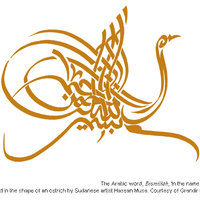
What is the meaning of SuJuD according to The Quran? - new article
-
Salaam Bigmo
You are just literally translating Arabic expressions into a different language and thus emptying them of their real meaning.
(48 29) Are you alluding at the "zabiba"? If so, why wouldn't the prophet be able to recognize the hypocrites if it was so obvious?Certain of the desert Arabs round about you are hypocrites, as well as (desert Arabs) among the Medina folk they are obstinate in hypocrisy thou knowest them not We know them twice shall We punish them and in addition shall they be sent to a grievous penalty. (9101).
As for translations from the Gospel, I always tend to not tread there. These are translations that reflect the understanding of whoever translated them, same problem with translations of the qur'aan. At least I can read the original language of the qur'aan.
Moreover, you bring a completely different verb which is "bow". This is neither "prostrate" nor "kneel ", and is not mentioned in the qur'aan, although it has miraculously been inserted in the "salaat".
Imagine that someone translates the sentence "They bowed to the Kings orders" into " ". Would you understand that this is all they did? Would you imagine that the King declared some order and everyone lowered their head wherever they were and went on with their affairs? Why take it literally with God's instructions?Body movements are only expressions of higher meanings, and they are not universal. Each culture has different meanings of these movements. African in general bow their heads when authority speaks to them. Police in the UK were specifically instructed in this because they translated this movement as a sign of not telling the truth according to the Western culture.
-
Guys just wanted to thank you for the excellent discussion.
Samia, I think this sums up your argument
So you're saying that the meaning of the word masjad implies no time limit, as in "a place of sujood", and that the jaami3 has been purposely called masjid to stop people from taking away that meaning?
Are you referring here to this?
Thanks for taking the effort to respond to my post/s
No. I am not discussing "salaat".
I do not even believe that people are instructed to pray together in a location except for the communal prayer. On the contrary, they are instructed to pray in their homes without being interrupted even by their own household(24 5.
What implications does this have on the meaning of masjid? If you don't believe it is a noun of place, and thus a building, then what do you believe? I don't think you've explicitly stated that yet.
You understand noun of place and noun of time. I presume you also understand the masdar mimi (verbal pronoun with initial M). Sjd originally means to obey or yield. Different situations or cultures have signs to deliver this meaning. An army would not prostrate their faces to the ground but would wave a white flag. But we cannot say (white flag means to yield). In some areas of Sudan in the past a white flag on a house meant (we sell alcohol).
A building can be constructed to carry out God's instructions like legislation chambres. This will be an extension to the meaning of msjd into a noun of place. The message of God carried by all messengers is the obedience of what He made unlawful (6 151-153) which is nothing other than the Straight Path. Ironically, Muslims go to the mosque five times a day, making at least 17 rak3aas in each of which they recite (Guide us to the Straight Path) seventeen times a day, but they do not know what this Straight Path is exactly. All they care about is how to stand, where to put their hands and how many beautiful places to construct in which to perform these movements. This obedience of the Straight Path should be the focus of the community and the individuals, wherever they are, and at any time, no matter what they are doing, hence the command(2 144, 150).
In verse 2 144 we also read
Who was the other messenger who looked up searching for answers? It was Ibrahim. He is the messenger who established the islam, which is nothing but the obedience of what God made unlawful. In other words, the Straight Path
(6 161).
This should be our focus/ qibla wherever we are whenever we be, not facing a meaningless building from time to time.
And "haraam" all over the qur'aan means "forbidden", never "sacred". "Sacred" has its own word.
What is the use of a "forbidden" building?EDIT just happened upon this verse whilst testing my idea
...
This seems to me to be quite obviously referring to a building
There is nothing here that gives further support to your understanding.
The first command of the Straight Path, otherwise known as the Ten Commandments, is to (not set associates with God). Whether msjd means obedience or legislation chambers, this command is valid. Actually it is valid everywhere, not just in a msjd. So it should not be exclusive to msjd even in your understanding of this word.
"kharaab chaos/ destruction" does no affect buildings only. Actually destruction of a building will happen by many other natural factors. Only Morals and Law are destructed by disobedience of God's Commandments. In fact all mosques mention hadiths and names of Scholars and their opinions and fatwas/ legislation. No msjd was destroyed.
However, making lawful any thing God made unlawful in the Straight Path will bring about chaos and fall of societies.
Enter Not necessarily a building(2 20
-
Salaam Samia, thanks for the reply, and sorry for the delayed response. I'm working 10-11 hours every day so it usually takes me a few days to get back to people now
No. I am not discussing "salaat".
I do not even believe that people are instructed to pray together in a location except for the communal prayer. On the contrary, they are instructed to pray in their homes without being interrupted even by their own household...What you say is technically correct, but it doesn't work in practice. Having many places of prayer is a practical necessity, a logical conclusion of the instruction to pray.
For example, I used to work in an office in the middle east. There was a small corner, 3 meters by 3 meters next to the elevator, and that was the designated prayer spot. When the time for each prayer began, everyone congregated there to pray. It wouldn't make any sense for us to all go back home to do it, and the nearest mosque was a distance away. It also wouldn't have made sense for everyone to congregate to that spot at the same time and then pray alone.
So communal prayer is a fact of life because we tend to not spend much time at home in this age.
Also, no one was forced to join. Sometimes you would have something important to do, so you would skip the congregational prayer and just do it alone a bit later. Even if everyone prayed alone, we would still need places of worship all around cities for people to do so at the correct timings, dawn, sunset, etc.
Islam is also an incredibly community-focused religion - possibly more so than any other religion. The Quran in my opinion places great concern on the destruction of social boundaries such as wealth, status, and race. So whilst you are right, we are instructed to pray at home, I think that communal prayer is an important aspect, as evidenced by the yawm-l-jum3a, and that mosques and places of worship then become a logical necessity.Sjd originally means to obey or yield. Different situations or cultures have signs to deliver this meaning. An army would not prostrate their faces to the ground but would wave a white flag. But we cannot say (white flag means to yield). In some areas of Sudan in the past a white flag on a house meant (we sell alcohol).
A building can be constructed to carry out God's instructions like legislation chambres. This will be an extension to the meaning of msjd into a noun of place.Yes, Sujood means yielding and obeying. However, I'd argue that the prostration is a universal sign of yielding and obeying. The ancient egyptians did it, and it has been done in various cultures in the past. In fact, I can't think of any culture where prostrating one's head to the ground could be interpreted in any way other than submission.
http//wwwdelivery.superstock.com/WI/223/1788/PreviewComp/SuperStock_1788-1584.jpgAncient Egyptian prostration. This is replete in ancient egyptian imagery
http//www.salvemariaregina.info/SalveMariaRegina/SMR-162/Christmas%20Prostration.jpgChristian Monks prostrating
http//www.thesacredseduction.com/wp-content/uploads/1431/10/images.jpegMore Christian prostration
http//yoga108.org/images/blog/2006/prostrated_monk.jpgBuddhist monk prostrating. The standing position in Buddhist prayer includes the words "I take refuge in the Buddha".
http//www.sfyoga.com/images/prostration.jpgHindu Prostration
http//www.answering-christianity.com/jews-2.jpgJewish prostration
http//yemitom.files.wordpress.com/2011/10/a-man-greeting-a-yoruba-king-oba1.jpgAfrican Yoruba man prostrating before tribal leader
One may always argue that this isn't a sign of anything, and that all these cultures have been copying each other.
However, I would argue that it is evidence of God's claim that he sent messengers to every nation. How else can you explain prostration in Japan to Samurai leaders, Buddhists saying "I take refuge in the Buddha" when they start their prayers, and most of all prostration amongst native american cultures, completely isolated from the rest of the world??Secondly, I also believe there is evidence in the Quran itself that prostration is intended with the head placed on the ground. I don't think it is a coincidence that the verb kharra is used in accordance with sujood. See verses 1958, 3215, and 17109.
A building can be constructed to carry out God's instructions like legislation chambres. This will be an extension to the meaning of msjd into a noun of place. The message of God carried by all messengers is the obedience of what He made unlawful (6 151-153) which is nothing other than the Straight Path.
Ok, some questions.
What exactly happens in these legislation chambers? Are they like a court of law?
Does congregational prayer also happen in them?
How do you explain that such buildings do not exist today in Islamic countries?
Is there evidence that they have ever existed?And why give an extension to the meaning of masjid into a noun of place, when you have been arguing that masjid isn't a noun of place and therefore should not be interpreted as a building? Sorry but I'm confused
Ironically, Muslims go to the mosque five times a day, making at least 17 rak3aas in each of which they recite (Guide us to the Straight Path) seventeen times a day, but they do not know what this Straight Path is exactly. All they care about is how to stand, where to put their hands and how many beautiful places to construct in which to perform these movements.
I think this is your own personal judgement. Yes, a lot of people are overly consumed with trivialities, but then again, many aren't. I wouldn't make a judgement as to the sincerity of people who make salah the traditional way, that's up to God.
This obedience of the Straight Path should be the focus of the community and the individuals, wherever they are, and at any time, no matter what they are doing...
Then why suggest a building for this exact purpose?
This should be our focus/ qibla wherever we are whenever we be, not facing a meaningless building from time to time.
And "haraam" all over the qur'aan means "forbidden", never "sacred". "Sacred" has its own word.
What is the use of a "forbidden" building?I think it's possible that you are taking haraam too literally. I thought about this before and just interpreted it as the logical conclusion of the word forbidden. As in, the masjid is an area where the haraam is always remembered and reminded - therefore it becomes sacred.
You're interpretation makes more sense though. It's really interesting and I have to think about it more before I make up my mind.
There is nothing here that gives further support to your understanding...
Yeah, you make good points. The reason I said it seemed to be clearly discussing an actual building is because of "an yadhkuru feehaa ismuhu" (that his name is remembered in it), and because of the second part ma kaana lahum an yadkhuluuhaa illaa khaa2ifeen (it is not for them to enter it except in fear).
Now that I look at it more carefully, it says "an yadkhuluuhaa". Singular. However, i'm still not sure how to translate this part if it's not talking about buildings. How are these people entering the masaajid in fear, if they are helping to ruin it?
Over all I think your argument for masjid al haraam is excellent. I think that we disagree on salah slightly, and on whether sujood contains a physical component of prostration.
I would say that I'm slowly coming round to your argument about masjid. I still interpret sujood the same way, but I'm open to the idea that masjid may be something else, as the basic meaning of sujood is submission or obedience.
I haven't read anything about grammar since middle school, so I have to research it more, but wikipedia says this about the masdar meemi
. .
It also gives the example (َ .
Instinctively, i get the feeling that the masdar meemi implies possession. Whilst sujood is an abstract term, masjid then becomes the sujood of someone, like the example nahaja is the abstract and manhaj is the nahaja of Omar.
Looking at masjid now with a new eye, I see a lot of possibilities
The usage of 3inda is odd. It should say "in" the masjid, if it were talking of a building, and not "at".
The second verse was translated by Muhammad Asad as Beautify yourselves' for every act of worshipThen again we get verses like 1821 that throws everything into confusion again...
I think I need to go through all the occurrences of masjid and really study this. But right now I'm tempted to translate sujood as I have before, and masjid as something like "act of worship" or "act of obedience".
So masjid al haraam would be the act of submission to what has been forbidden
And that interpretation fits rather well with 2144, saying that we should turn our faces, or keep our bearing towards the obedience of what has been forbidden.Sorry for the long post
-
The usage of 3inda is odd. It should say "in" the masjid, if it were talking of a building, and not "at".
The second verse was translated by Muhammad Asad as Beautify yourselves' for every act of worshipSalaam ths,
Since long I am wondering why is used in 729 and 731 but has no clue yet . Besides this there is "in the masjid" available in AlQuraan.
2114
9108
May Allah guide us all to His true path pr
Mohammed M. Khan -
Salaam ths
Sorry for the late reply.
I just have one question about all these photos
Who are these people prostrating for? And where's the person, or the symbol of that person or god situated?The answer is that they prostrate to a king or a statute representing their god situated in front of them.
So, to whom are Muslims prostrating? Is the kaaba our symbol of God, just like the cross to Christians and the Buddha to the Buddhist? What if I prostrate to another direction? Where did God say He is represented by anything or even asked us to prostrate towards the Kaaba?
In this case you cannot use the symbol of obedience (prostration) instead of the original meaning of the word which is "obedience", because "prostration" has its rules that do not fit with what God means to us. -
peace all,
peace all,
New mini-article The Quran and 2196 - a lesson in critical thinking
http//www.islam-and-muslims.com/articles/Quran-2196-critical-thinking.html
I just realised, if my study is correct, then 2196 is the first verse you should check to see if your view of hajj/umrah/al masjid al haram etc etc actually works.
If it fits, based on the filters I have laid out, then you are very likely onto something. If not, you may have to go back to the drawing board.
Interestingly, no-one thus far has posted any alternative that works, based on my filters. I posted this in several places. I know alternative views exist, but how many work? I at least expected some to claim such a thing, but no claim from those holding the traditonalist position nor unorthodox alternatives. Zero.
Oh well. Admittedly, 2196 is a highly intricate verse, and in my view, will no doubt serve to smash many incorrect understandings.
Those who listen to what is being said, then follow the best of it.
These are the ones God has guided, and these are the ones who possess intelligence. -
1315
Filter concept of Wakas
Can one accept the following translations as the statement of fact mentioned in the Arabic Text of above Ayah? Four billion people, perhaps including the author of thread, do not prostrate to Allah. This is ground reality. How can these translations, contradictory to fact on ground, be accepted and relied upon for authoring articles?
Sahih International And to Allah prostrates whoever is within the heavens and the earth, willingly or by compulsion, and their shadows in the mornings and the afternoons.
Pickthall And unto Allah falleth prostrate whosoever is in the heavens and the earth, willingly or unwillingly, as do their shadows in the morning and the evening hours.
Yusuf Ali Whatever beings there are in the heavens and the earth do prostrate themselves to Allah (Acknowledging subjection),- with good-will or in spite of themselves so do their shadows in the morning and evenings.
Shakir And whoever is in the heavens and the earth makes obeisance to Allah only, willingly and unwillingly, and their shadows too at morn and eve.
Muhammad Sarwar All in the heavens and the earth prostrate themselves before God, either of their own free will or by force, just as do their shadows in the mornings and evenings.
Mohsin Khan And unto Allah (Alone) falls in prostration whoever is in the heavens and the earth, willingly or unwillingly, and so do their shadows in the mornings and in the afternoons.
Arberry To God bow all who are in the heavens and the earth, willingly or unwillingly, as do their shadows also in the mornings and the evenings.
Progressive Muslims And to God prostrate all who are in the heavens and the Earth, willingly and unwillingly, as do their shadows in the morning and the evening.
Rashad Khalifa To God prostrates everyone in the heavens and the earth, willingly and unwillingly, as do their shadows in the mornings and the evenings. -
peace all,
Part 2 of the study discussing the term "masjid" in Quran, click below
What is the meaning of maSJiD according to The Quran? Time will tell
It was originally meant to discuss "al masjid al haram" and "al masjid al aqsa" as well, but due to life and laziness I have been delayed, so I thought I'd make that into a part 3, and post what I have so far. Nothing of great significance but an analysis nonetheless.
Background Part 1
-
Thanks for the link bro Mazhar. I assume you regard "masjid" to mean "mosque" going by your article, however I did not see 1821 nor 2187 analysed, which are the most problematic thus far, for that view.
If you have analysed them, please link me to it. Thanks.
-
Peace, brother Wakas,
29 occurrences with different spellings are counted under this
- Sublime and sincere Prostration of human beings-Bowing and curving to lay the forehead on the Earth denoting absolute surrender and sublime adoration.
We now move forward, from the entire created Realm to Human being for whom all that was created which exists in the Skies and the Earth . Moreover, the Human Being was the one who was considered worthy of the basic and initial meanings of the Word -an act-a gesture of recognizing and paying respect and obeisance by the already existing created species Angels and Jinn represented by Ieb'lees.
However, at this stage we must keep in mind that the basic meanings of a Root and word do not exhaust when they are used in a different semantic field, relational area, while necessarily retaining the base meanings. This phenomenon is particular to the words which are other than those coined to denote and identify a specific tangible object, or person, i.e. substantive nouns. Actions and gestures, bodily actions or body language has various levels of intensity, depth, magnitude proportionally reflecting the feel and state of heart and mind.
Here in this ultimate semantic field the Glorified and Revered is Allah the Exalted, and the subject of Verb is the Man, meaning "You, the Man, acknowledge in reverence and fear the Glory and Exalted Position of your Sustainer Lord and express it by extreme gesture of placing the forehead on ground".
Consider that who could be more unjust than the one who hindered/forbade the Mosques of Allah, the Exalted that therein the Name of Him should be celebrated, and he strived for the ruining of their sanctity?
The purpose of visiting these locations is the remembrance, verbally orating, celebration of the Name of Allah the Exalted. This is the basic and foremost meanings of the Root, the first step of feel and acknowledgement. Since the Revered is the Mightiest of the mighty, a field of behaviour modification is added in the base meanings, i.e. an element of fear gets added to reverence
They are the people for whom it was not befitting that they should themselves have entered therein except like those who fear Allah, the Exalted.
A location Noun is a derived Noun from Verbal Noun designating a Location where the act is performed by the Active Participles of this Verbal Noun "Sajidoon".
-
peace all,
Since bro Mazhar has seemingly declined from answering my request, it is open for others
If you think masjid as 'mosque' OR 'institution of obedience' then please explain your view on 1821 and 2187.
(see article for analysis)This will help myself, and readers, better understand this position. Thanks.
-
peace all,
Since bro Mazhar has seemingly declined from answering my request, it is open for others
If you think masjid as 'mosque' OR 'institution of obedience' then please explain your view on 1821 and 2187.
(see article for analysis)This will help myself, and readers, better understand this position. Thanks.
Sorry brother Wakas,
It is otherway round. You seem to be afraid reading the article that contains all the occurrences, that it might shatter all what you built erroneously on preconcieved thoughs about prayer and prostration etc. That containes references of all the authentic and reliable classical lexicons.
Noun of location is derived from a Verb {perhaps derivation phenomenon you think not worth understanding]. And a verb denotes only an action-activity-something relation to kinetic energy not potential energy. Location is for the performance of that action.
-
1821 And like that We made known about them that they might know that God's promise is true and that the Hour there is no doubt in it. When they disputed amongst themselves about their issue, so said "Build over/upon them a building". Their Lord knows best about them. Those who prevailed on their issue said "Surely we will take* (to ourselves) over/upon them a maSJD."
*verb form 8, reflexive.Interestingly, almost all translators seemingly neglect certain aspects of this verse
Firstly, they imply a physical building was built (worse still, a Mosque) over them (i.e. their graves), as some sort of shrine in their memory, which is completely against the message of The Quran (i.e. no saint/human reverence). Some commentators do not distinguish whether this was a good or bad thing, i.e. do not clarify who "prevailed" in the dispute, the right view or wrong view. The flow and logic of the verse would imply those who prevailed were in the right, otherwise there would be little point ending on this note. It seems most commentators have this view also.
Secondly, it clearly states there is a dispute and some said "build a building over/upon them" yet it later says those who prevailed said "surely we will take (to ourselves) a maSJD over/upon them" clearly implying there must be a significant difference between each side's position. If traditionally understood, the only difference is one argues for a building, the other argues for a Mosque. What kind of building would have been built by the former side? It would most likely be a communal building, i.e. a Mosque-type building, thus trying to determine the difference in their arguments is difficult going by the traditional understanding. As a side note, Asad makes a reasonable interpretation of the term "over/upon them" as "in their memory", which seems plausible.
Thirdly, the former expression uses "build a building..." and the latter uses "take (to ourselves) a maSJD...", as if they were both about building why not use the same word? Not to mention "take to ourselves (a building)" doesn't quite make sense, as it implies a pre-existing thing. To check this, out of 128 occurrences of this specific verb form there are five occurrences that may refer to "taking for/to oneself a structure/building" and they are2941 (implies pre-existing thing)
9108 (unclear)774 - "take FROM (partitive) its plains palaces" (plains are pre-existing) or from context may refer to existing Thamud structures
26129 (implies pre-existing thing)
1668 (implies pre-existing thing)
Thus, the evidence is weighted in favour of a pre-existing thing. To use a reflexive verb such as this, to refer to building/creating something anew seems odd. To refute this, evidence to the contrary would have to be brought. Interestingly, this simple observation helped illuminate the parable of the spider click to read.
Lastly, since it implies the ones who prevailed had it right, we must ask ourselves what is the message of this verse? Well, clearly for the people in question God gave them a sign in this story. After this lesson, they disputed, some said "build a building over them" and in-between the other side's argument it says 'Their Lord knows best about them' (also mentioned in subsequent verses), implying their number or who they were is not the point, thus no need for a building, as their Lord knows best about them, and it is the outcome/lesson of the story or God's will prevailing that is important. Also, in 1822 it says "do not dispute about them except with an argument obvious/apparent", and since AQ does not clarify their number which seems to be the main dispute, the primary obvious/apparent argument is the lesson of their story, and this is what people should be reminded of and take to themselves.
Background reading for some traditional perspectivesPlease first form your opinion as to what is that thing in your mind and what exactly is derived by this debate, whereupon someone could say something. You are at your own thinking as if you have made some conclusion while there is none in the above para and are yet asking to refute it. Refute what?
-
2187 Lawful for you nights (of) the abstinence is sexual approach* to your women, they are a garment for you and you are a garment for them. God knows that you used to betray/deceive yourselves so He turned towards you and He forgave you; so now approach** them and seek what God has decreed/written for you. And eat and drink until becomes distinct the white thread from the black thread, of dawn. Then you shall complete the abstinence until the night, and do not approach** them while you are devoting/cleaving in the maSaJiD. These are God's boundaries, so do not transgress them. It is thus that God makes His revelations clear to the people that they may be righteous/God-concious.
*Arabic RaFaTh (root Ra-Fa-Tha)
**Arabic BaShiR (root Ba-Shin-Ra)IF one takes masajid=mosques then if women were not allowed in them, it would make this statement illogical, thus clearly implying women could be present in the mosques. It also implies men and women are unlikely to be segregated, as they could approach one another, i.e. interact.
Who in their right mind would approach their wife in a sexual manner in a public Mosque? Was this such a temptation or common practice that AQ had to tell them not to do it? According to history/tradition mosques in those early days were very basic or simply courtyards thus unlikely to have multiple rooms so it seems even more odd to suggest such a thing taking place in a Mosque. This traditional understanding verges on the nonsensical.
IF masajids=mosques, why even mention mosques, when there is much greater chance of sexual temptation in the homes during abstinence? The traditional commentators attempt an explanation for this, e.g Jalalayn/Ibn Kathir say this is referring to 'itikaf' (spiritual retreat in the mosque) when believers would leave the mosque for sex then return, when they are meant to reside at the mosque for a certain number of days. This is a complete insertion of course, and hardly "clear" as it implies at the end of the verse, and the obvious error as it says "...WHILE YOU are devoting/cleaving IN the masajid" not when one leaves them. So, it would seem they interpret it as "...while you are staying in the masajid (for itikaf)...".
If it did mean 'itikaf' then this is not explained elsewhere in AQ, e.g. how many days, what does it involve, why, is it obligatory, examples of anyone actually doing it etc. If we are relying upon AQ only for our understanding of this verse, then 'itikaf' must be rejected outright. The consequence of this however, is that it renders the understanding of masajid=mosques illogical, or at least very unusual.Is there any conclusion drawn, an opinion rendered; or even something sensical in analysis that needs refutation?