
The Circular Reasoning of Hadith Rejectors - A Refutation
-
A Refutation to:
The Circular Reasoning of Hadith Rejectors
https://www.youtube.com/watch?v=oNrNVuV7V4AAn objective refutation of the video’s core argument ("The Circular Reasoning of Hadith Rejectors") demonstrates why the Quranist position—that Hadith is not strictly necessary to define or validate "What is the Quran"—is logically and epistemologically coherent.
The counter-argument rests on four distinct structural counter-points that dismantle the video's charge of circular reasoning.
1. The Category Error: Confusing Textual Self-Definition with External Authentication
The video’s premise hinges on asking: "How do you know this physical book is the Quran without using Hadith?" This conflates two completely different philosophical inquiries :Internal Definition (What is the Quran conceptually?): The Quran defines its own boundary, identity, structure, and nature internally (e.g., al-Kitāb, al-Furqān, Tabyān). Understanding what the text purports to be is an act of reading comprehension, not circular logic.
External Identification (Which physical object contains this text?): Verifying that a printed book matches a historical manuscript is a standard problem of material history, shared by all ancient texts (e.g., Homer’s Iliad, Plato’s Republic).Relying on external physical markers, paleography, radiocarbon dating, or living linguistic traditions to identify a physical copy does not require accepting a secondary religious corpus like Hadith.
2. Historical Tawatur vs. Hadith Literature
The video treats "Hadith" and "Historical Transmission" as identical concepts. This is a critical historical and methodological error.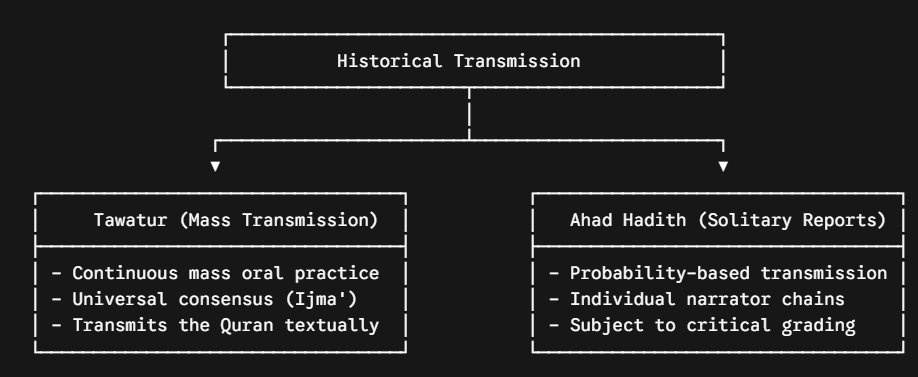
The Distinction: The Quran was transmitted via Tawatur—universal, continuous mass-oral recitation and manuscript preservation by whole generations.
The Refutation: Hadith literature (the Kutub al-Sittah, compiled 200+ years later) consists largely of Ahad (solitary/isolated) reports.
Logical Conclusion: One can accept the mass historical fact of the Quran's textual existence (Tawatur) through raw historical tradition without accepting the theological authority or historical accuracy of the Hadith corpus.
3. The Infinite Regress Fallacy of the Traditionalist Premise
If the traditionalist in the video asserts that Text A(Quran) cannot prove its own identity and requires Source B (Hadith) to define and validate it, a fatal logical breakdown occurs:How do you validate Source B(Hadith)?
If Hadith is authenticated by its own narrator chains (Isnad), it is committing the exact same "circular reasoning" the speaker accused the Quranist of using.
If Hadith requires Source C to prove its validity, it triggers an infinite regress (A-.>B-> c).
If Hadith is validated by the Quran (B->C), it forms a genuine circular dependency.By demanding an external religious text to validate the primary text, the traditionalist's argument collapses into the very circularity it claims to expose.
4. Semantic Self-Clarity and Internal
a structural and linguistic perspective (as seen in semantic studies of the text):Self-Referentiality as Systemic Boundary: The text constructs its own conceptual envelope. It specifies its internal language (Arabic), its structure (Ayat, Surahs), and its functional scope.
Empirical Verification via Textual Consistency: A recipient evaluates a text's identity through its structural, stylistic, and thematic cohesion. Reading a text to evaluate whether it matches its claimed internal identity is standard analytical practice, not circularity—just as reading a geometry textbook to determine whether it is a geometry textbook is standard empirical verification.
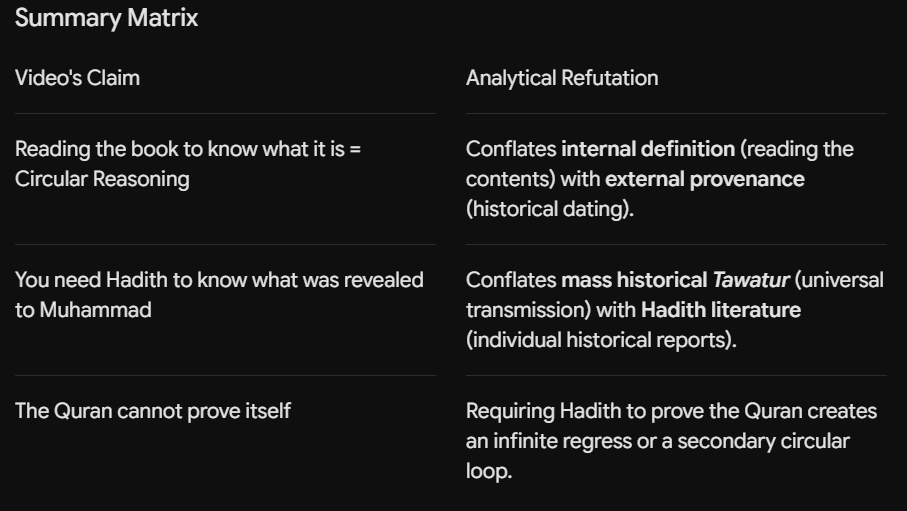
Final Conclusion: Hadith rejectors are epistemologically justified in asserting that Hadith literature is unnecessary to define or validate "What is the Quran," because textual definition relies on internal semantics, while historical preservation relies on universal mass transmission (Tawatur) and material manuscript history—neither of which depends on the Hadith corpus.
Above is AI assisted.
-
There is a fundamental error in the Traditionalist claim. They imply they know The Quran is The Quran, from hadith, when in reality, their "knowing" is probabilistic. So they do not know for certain.
That is why in academia AFAIK their alleged way of knowing Quran is Quran is not accepted.
