
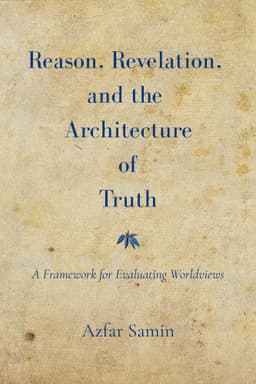
Book: Reason, Revelation and the Architecture of Truth: A Framework for Evaluating Worldviews
-
Why do intelligent people, looking at the same evidence, reach completely different conclusions?
We often assume disagreement exists because one side lacks intelligence, education, or evidence.
I don't think that's the real problem.
My argument is that people disagree because they begin from different first principles.This led me to ask a deeper question: how do people form beliefs?
Before any evidence is interpreted, we have already adopted assumptions about reality, knowledge, morality, authority, and truth. Those assumptions become the architecture through which we interpret everything else.
These questions eventually led me to write Reason, Revelation, and the Architecture of Truth: A Framework for Evaluating Worldviews, which asks whether there is a structured way to evaluate competing worldviews without assuming one is true from the outset.Rather than asking, "Which worldview is true?", the book begins with a more fundamental question: What criteria should we use to test truth claims about reality?
The framework evaluates worldviews by asking three questions:
• Are their first principles internally coherent?
• Do their claims correspond with reality and empirical evidence?
• Do they provide a reliable criterion for distinguishing truth from error when lived reality diverges from our deeply held beliefs?The book then applies those same standards to the Qur'an itself as a book of knowledge, rather than asking readers to accept its claims on authority alone.
The same criteria are applied to every worldview. The conclusions, however, are not assumed to be equal.Whether you ultimately agree or disagree with my conclusions, I hope the framework encourages deeper reflection about how we form our beliefs—and how we test them.
The Kindle edition is available free this week.
If you prefer a printed copy, all author royalties are donated to charity.
Download for free: https://www.cccframework.ca/mybooks