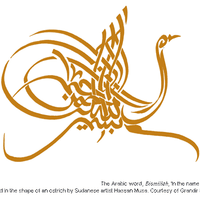
A Perspective on Salah
-
Peace,
Two and a half years after my initial post, I feel that I need to update the community with my latest understanding of salah.
Ninety percent of what I posted back in 2008 still holds firm. That is
I still think that salah is a time in which one remembers God by giving thanks, asking for forgiveness, being aware of the Resurrection, recognising the magnificence of God, and like matters.
I still think that one should be standing and facing al-masjid al-haram (which I believe to be in Makkah).
I still think that salah involves physical prostration and bowing with no particular pattern.
I still think that the tone of voice during salah should neither be suppressed nor manifested.
I still think that the evening salah begins a little before sunset and ends at nightfall.
I still think that the dawn salah begins long before daybreak and ends a little after sunrise.
The only modification in my understanding of salah involves its frequency I no longer think that the afternoon salah exists at all. I couldn't satisfy myself - based solely on 2238 - that an afternoon salah exists. This is mainly because the 2 verses which specify the temporal loci of salah (11114 and 177 both mention the dawn and evening but neither of them gives a mention to the afternoon. So, my logic is that if an afternoon salah did exist then its temporal locus would have been given the same significance as the other two; but it hasn't.
It should be noted that this interpretation could very well be subjected to bias because 2 salahs are fewer than 3, and I'm a lazy guy, so go figure. On the other hand, my argument could very well be based on sound reasoning as I've presented it above.
This would still leave a number of points unexplained. Of which
-
How does one explain al-wustaa in 2238?
-
How does one explain the use of the plural al-salawaat throughout the Quran (which signifies 3 or more)?
My studies are on-going.
-
-
Wakas,
Thanks for the link bro. Your article shows a great level of deep and cohesive research with rational inferences.
I have never had a doubt that sujood can imply a mental state of humility, reverence, and subordination; this has been one of its meanings in the Arabic language even before the Quran came down.
But I also have no doubt that sujood can also imply physical prostration; this is also one of its meanings in the Arabic language.
In my view, neither viewpoint can be invalidated; they both hold true.
Perhaps performing physical prostration is so synonymous with mental humility and reverence that doing one necessitates the occurrence of the other.
When I perform salah, I try to attain a state of mental sujood, and I also perform physical prostrations, so which ever of the two meanings The Author intended, I am in compliance either way.
I have read your previous article on salah and it is very interesting, however, I am still unsure as to your understanding. What do you mean by bond? Or, if I may be so direct, what exactly do you do during the times of sunrise and sunset?
-
peace bro,
Nice to see you post.
In my view, neither viewpoint can be invalidated; they both hold true.
I agree, hence at the end I said "It simply means that no credible argument for SJD=prostration and therefore prostration during upholding/establishing the salat can be made using The Quran.".
...so which ever of the two meanings The Author intended, I am in compliance either way.
I agree. When it comes to personal preferences for one how supplicates, prays, thanks/praises God etc I have no issue whatsoever.
My only issue is if someone says AQ says SJD=prostration and/or tells others they must do it etc. As a side note I recommend to all, the next time someone says this to you, simply ask them the points raised in the article, e.g. 4102, and you will soon see the level of study/analysis that they have done.Bond see meanings 4-7
As per my understanding The regular/timed salat/bond is for the mumineen. It can be individually done or as a group. It would involve reading/reciting/study/oration/reflection of The Quran.
Upholding/establishing the bond is directly related to knowing what the bond entails. One goes with the other, hence the command for those upholding The Quran, the mumineen.
-
http//free-minds.org/forum/index.php?topic=7365.msg56324#msg56324
AFAIK when SBH is mentioned at specific times it is always in the singular. And if we take the times literally and either as salat or part of it, I found it impossible to make them work, thus they are likely hyperbole/idiomatic statements.
-
Yes, I agree that it is hard to make all the specified times of tasbeeh fit with the times of salah; total consistency doesn't exist. Nevertheless, because there is still some correlation (e.g. "before the rising of the sun and before its setting" I choose to consider tasbeeh a part of salah.
What's your position on 56?
-
There are two aspects to the SBH question
-
IF one takes SBH when mentioned along with a time as = salat, then can one make them fit time-wise? I consider this impossible and I have not read an article attempting to do so.
-
What is SBH? Once we understand this, we can determine if upholding/establishing the regular/timed salat is an act of SBH itself or not. Thus, potentially making "SBH is part of salat" moot.
My take on 56 is the same as the commonly accepted translation.
-
-
Salaam uq,
I really enjoyed your article on salah. I think you've done some great research here and I'm glad to say that I'm in agreement with you on most of your interpretations.
I also think that salah is mainly about remembrance. Remembrance through asking for forgiveness, mercy, direction, and through praise and the study of the Quran.
I also think that tasbih is an important part of the salah. I'm also on the fence about tasbih, but I think that the way it is mentioned is thematically connected to salah, and I don't think it is a coincidence that tasbih has always been a part of salah as we know it today. I believe despite being a part of salah, it can be done outside of salah as well.
I also think that salah involves standing and facing masjid al-haram in Makkah.
I also think that salah involves the physical acts of prostration, bowing, and standing, in no particular order or frequency. However I do believe salah should be ended at prostration.
I also believe that salah is mainly a matter of the heart.
However, I believe that there are either 3 or 5 timings for salah during the day. I've undertaken my own studies and posted them here, but they are old and in need of updating.
Anyway good job. Keep at it, and please keep posting your thoughts/research!
-
Salaam ths!
It pleases me that you enjoyed the article.
I am also quite intrigued that we are in agreement concerning most aspects of salah.
The problem of tasbeeh is one which I also faced during my studies. I resolved the problem by the following 2 arguments
-
A temporal locus must be given in relation to the command "aqim al-salah", thus, if the Designer of Nebulae mentions a time of day or night (e.g. al-aseel, al-bukrah, aanaa' al-layl) without issuing the command "aqim al-salah", then that time quite simply, in my opinion, does not refer to salah.
-
Tasbeeh is clearly something which we are instructed to do at many points during the day and night, some of which coincide with the times of salah, this tasbeeh is also to be done within salah itself, as well as outside salah.
I also end salah with a prostration, if nothing but as a mark of respect and reverence.
On another note, I know I bang on about this all the time, but I'll mention it again regardless. Free-minds.org is a massive blessing from God, it brings the believers together from all 4 corners of the earth who otherwise would probably not have known about each other. Free-minds.org also serves as a platform for the testing of ideas and for the refinement or rejection thereof.
I am truly grateful to God for this technological blessing.
Usamah
-
-
Furthermore, I would not necessarily restrict tasbeeh to the mere utterance of words, but I would also include in its scope one's actual cognizance of the magnificence and of the irreproducible uniqueness of God, the Definer of Time, the Proportioner of Space, the Giver of Existence, the Qualifier of Matter, the Quantifier of Energy, the Designer of Nebulae...
http//www.google.com/search?q=nebulae&hl=en&safe=off&client=firefox-a&hs=wW7&rls=org.mozillaen-USofficial&prmd=ivns&source=lnms&tbm=isch&ei=zQBXTqi5Ece2hQfHiPSaDA&sa=X&oi=mode_link&ct=mode&cd=2&ved=0CBQQ_AUoAQ&biw=1032&bih=599
"wa-in min shay'in illaa yusabbihu bi-hamdih"
-
I would like to add that the temporal loci of salaah have been defined in the Quran by the measure of the sun's proximity to the horizon and by the measure of the amount of light in the sky, that is "li dulooki 'sh-shamsi ilaa ghasaqi 'l-layl". This applies to salaatu 'l-3ishaa', and, based on my studies, I believe the same would apply to salaatu 'l-fajr.
However, there are 2 factors affecting the calculation of the times of salaah
-
A "breathing" twilight (al-sajsaj in Arabic ). This is caused by the seasons and the earth's position relative to the sun throughout the year. Thus, the twilight "expands" and "contracts" in terms of its duration, hence my use of "breathing".
-
Solar angular ascent and descent. This too is caused by the earth's position relative to the sun throughout the year. Thus, the rising and setting of the sun, relative to a fixed point in the sky, takes less time in summer due to a near-obtuse angular ascent and descent. The opposite is true in winter.
Therefore, in light of the above, one can only use the times of the sun's rising and setting as approximate values for the determination of the times of salah, because the 2 above-mentioned factors would invariably affect the times of salaah to a notable degree.
Thus, one would be in a better position to use solar altitude and depression as markers of the start and end of salaah. For no matter what the position of the earth is relative to the sun, solar altitude and depression will mark the same astronomical states, invariably.
I use the following values solar altitude at 5o; solar depression at 10o.
These data can be found at Her Majesty's Nautical Almanac Office, the data are computable according to your geographical co-ordinates of latitude and longitude.
Simply follow the instructions on screen http//astro.ukho.gov.uk/surfbin/placefinder.cgi?program=Rise_Set&ticket=86dc57024e8f31f3.
I have recently begun to use the sun's altitude and depression as markers for the start and end of salaah.
This is my latest.
Peace!
-
-
Thank you uq for these excellent and serious posts, and I thank all the contributors that you've inspired to answer with all their links too, which I read with much appreciation.
I myself struggle with the understanding of the salat, as evidenced in my posts, and topics I started.
It is two or three weeks now that I stopped performing the "choreographed" ritual prayer, replacing it with mental bond and remembrance to God, but I feel that I'm missing something...I also liked your words HERE
On another note, I know I bang on about this all the time, but I'll mention it again regardless. Free-minds.org is a massive blessing from God, it brings the believers together from all 4 corners of the earth who otherwise would probably not have known about each other. Free-minds.org also serves as a platform for the testing of ideas and for the refinement or rejection thereof.
I am truly grateful to God for this technological blessing.
UsamahAnd I subscribe to that, too!
Thank you all for your kind and amazingly illuminating contributions, I am surprised how much do people know and study! -
Thank you uq
Tell us more about your geometrical observations please!
but I would also include in its scope one's actual cognizance of the magnificence and of the irreproducible uniqueness of God, the Definer of Time, the Proportioner of Space, the Giver of Existence, the Qualifier of Matter, the Quantifier of Energy, the Designer of Nebulae...
Expound!!! In the proportion is the song of the birds...
Pay attention to proportion, it is the only constant!
Peace
-
@ GODsubmitter,
Thank you for your input. Please do share your ideas, and keep us updated.
@ OPF,
Thank you. By listing those attributes, I intended to justify my tasbee7/glorification of God, that is to say, God is well-worthy of glorification. Such is tasbee7.
Peace.
-
Peace everyone!
Thanks uq for the extensive article! it's really well informative & well composed
I would like to note that "ila" in 1778-79 mean cam mean"until".as in 218746)
"Until the night"
~ May His Supreme Majesty guide us to the correct path ~ -
Salaam Uq,
I think you'd be interested in this.
I've come to disagree with the traditional interpretation of 1778, and figured you would be interested given your previous ambivalence regarding the number of prayers in the Quran.
I started a new topic to encourage discussion about it. It is here
Please let me know your thoughts,
Salaam