If Allah wants things to be easy for us, why so much confusion about salat?
-
Salaam Ayman,
This contradicts what you said earlier here about "kharruu lil2adhqaan" being the idiom
You are changing your mind and repeating a traditional argument that only "lil2adhqaan" is the idiom and not "kharruu lil2adhqaan".
No I wasn't posing it as my own argument. Personally I feel that Lane's use of the idiom is more correct. I was posing this as new information that I had just found for everyone to mull over.
Here they compare the expression to the idiom of using a part to indicate a whole. However, this is a false analogy. If you read the poem carefully, the idiom is using the hands and mouth to indicate that the whole body fell. It is not using the hands and mouth to indicate that physically a different part of his body such as the knees fell.
Yeah I agree. I was rushing too much and hadn't noticed this. I was too pleased with the new information on rotation of prepositions.
Now if you are interested in analysing the idiom in more depth, what you will notice as you physically prostrate to your chin is that it is physically impossible for the chin and the forehead to touch the ground at the same time.
Come on Ayman?there's no need to state the obvious and insult my intelligence.
The passage is essentially telling you on so many levels that whether you interpret it idiomatically or physically, break each word individually or put the words together, the traditional prostration to the forehead is not what is meant.
I honestly believe that your interpretation is the less likely of the 2?and here's why
If we are to take your interpretation of this sentence, then we are to believe that the whole phrase is entirely idiomatic - i.e. the entire phrase put together means that they fell mentally hearing and obeying God (hearing and obeying is your interpretation of sujood right?), or their pride collapsed as they heard and obeyed God.
So that is 1 possibility. And by no means a bad one.
But if you're going to take this position, then you're also taking the position that Lane's Lexicon is entirely false when he states the following examples for kharruu lil2adhqaan
(of a stone)
These examples make perfect sense, and are consistent with what I've been saying.
So are there any other instances where you've disagreed with Lane's definitions?
Is this the first time?
And if you are disagreeing with it 100%, can you state why your interpretation is more likely to be correct?If I try to be as unbiased as I can be, and weigh the likelihood of the two possibilities, I come to the conclusion that Lane's examples here are more likely to be correct than yours.
This is because
-
Kharruu lil2adhqaan is repeated 2 verses later with bakiyyan - this ties it with an extreme state of khushoo3 and khudoo3 and lends it the meaning "to collapse", or "to fall to the ground swiftly or earnestly".
-
Looking at all the other examples of the usage of khrr in the Quran, (I listed them all here) it is never used as a metaphor, not even once, unless you count kharruu deaf and blind from 2573, for which there is an obvious explanation they physically prostrate but are deaf and blind when they do it, i.e. not focused at all on what they're doing.
Also, there are instances of the use of khrr that are 100% undeniably physical, such as 1990, 1626, 2231, 3414, etc etc.
Now, just to preemptively avoid you having to bring this up and then requiring a response from me I definitely do not believe that the Quran has one meaning for a word in every context. The Quran doesn't - it has different meanings in different contexts.
What I AM trying to say, is that there is no evidence of the word khrr being used as an idiom anywhere else in the Quran. This by itself is not enough evidence to prove my position, but it's one point in a group of points that together make the chance of the entire phrase being an idiom less likely.- If we take sujood to be the traditional prostration to the head, then it renders adhqaan here to obviously be an idiom. You can then argue that this is a circular argument. But you are taking sujood to NOT mean physical prostration to the forehead, and thus have to render kharruu lil2adhqaan to be an idiom altogether - an equally circular argument.
You see the problem that the Sunni fellows were trying to solve is not the idiom but it is "lil2adhqaan" (to the chins).
True, but aren't you doing the exact same thing? You don't like the literal meaning of prostrating to the chin either, and have thus rendered the whole passage as an idiom. So you can hardly blame the sunnis now can you?
- If you take this entire phrase to be an idiom, what is your position on 3215 (kharruu sujjadan), 3824 (kharra raaki3an wa2anaaba)? Are they idioms too? If so, have you then found an alternate meaning for raaki3an?
At the very least, Ayman, you have to admit that this argument is far from obvious, and that both sides could be argued till the cows come home. Personally I think a professional linguist should be consulted to see if Lane's examples were made up by himself and based on the verse in the Quran, or if he actually heard or read those examples in other poetry..
-
-
- Looking at all the other examples of the usage of khrr in the Quran, (I listed them all here) it is never used as a metaphor, not even once, unless you count kharruu deaf and blind from 2573, for which there is an obvious explanation they physically prostrate but are deaf and blind when they do it, i.e. not focused at all on what they're doing.
Completely incorrect. The Arabic CLEARLY states the falling/khrr is done upon the ayatin/signs, by the feminine pronoun "ha" in "alayha" !!!!!!
Not only that, your so-called obvious explanation can be refuted by logic, as it implies they in part heard the command to fall but not other parts. So can apparently hear&obey at first but not immediately after. Nonsense.- If we take sujood to be the traditional prostration to the head, then it renders adhqaan here to obviously be an idiom. You can then argue that this is a circular argument. But you are taking sujood to NOT mean physical prostration to the forehead, and thus have to render kharruu lil2adhqaan to be an idiom altogether - an equally circular argument.
No. A circular argument is one in which there is no other supporting evidence other than the claim itself. SJD not meaning physical prostration to the forehead is all over The Quran.
-
Wakas, as you've so many times preferred to accuse me of, you don't seem to able to read properly. I've told you several times that I'm in no mood to discuss this with you as
a) you don't seem to have been taught proper etiquette
b) you're more focused on proving me wrong than on finding the truth about anything in an amicable discussion amongst interested parties
c) you don't even know arabic, so your participating in this discussion...no, arrogant and stubborn ridiculing within this discussion, is as laughable as me telling a Chinese guy how to understand Chinese idioms - that are written in Chinese! Using google translate and a dictionary no less! And then mocking HIM! And then telling him HE's not understanding basic Chinese!
d) if you can't understand my above point then you're pride and obvious narcissism are clouding your judgment, and won't even allow you do admit that this is out of your scope, but you're continuing to mock and ridicule and make laughable comments like the above.If you want to understand more about Arabic prepositions, and find the answer to your insolently posed argument above, then feel free to stick this site into google translate http//vb.arabsgate.com/showthread.php?t=492742
And to learn proper etiquette and manners befitting a Muslim, stick this site into google translate http//www.alfaseeh.com/vb/showthread.php?7788-%DE%C7%E1-%CA%DA%C7%E1%EC-%ED%CE%D1%E6%E4-%E1%E1%C3%D0%DE%C7%E4-%D3%CC%CF%C7
Like I said before, I'm not going to waste any time hair-splitting the word "alayha" with you and all it's possible delineations...my explanation of that verse is 100% befitting the Arabic language. Translate the link and read it for yourself.
Salaam
P.S
-
One thing that baffles me is how can one debate or argue a point if they don't understand the language of the debate in the first place?
It's like you telling Bill Gates how to write a computer programme whilst you have never seen a computer in your life and are living in a remote village in the 1500's.
This is similar to me asking my staff member to make me a cup of tea including milk and sugar, and they come back telling me that my car tyre has a puncture which is parked in the parking lot, expecting me to accept this as the cup of tea, when everyone else in the world knows that the basics of tea include water, tea leafs/tea bags/tea granules.
Wakas, my dear friend, this is exactly how I see your interpretation of Sujood/Prostration. Absolutely ridiculous.
Peace
-
ths,
Thanks for once again giving us a subjective rant, now back to the discussion
I would be very interested to see how your interpretation of 2573 is 100% befitting the Arabic. Unfortunately, since you lack credibility in my view, I will wait to see if someone knowledgeable of Arabic confirms/denies your claim. If not, I will ask a professional Arabic linguist myself.
zulu, thanks for your subjective opinion. Unfortunately for you, Al Quran never says "those most knowledgeable of Arabic will understand it best" or similar. I'm glad it doesn't say this because if it did it would be a logical fallacy and thus disprove itself. However, this position assumes an underlying respect for logical argument.
-
Salaam
Now you as me has come to conclusion that blind obedience is blind,
and rituals is as most Muslims do, are just that BLIND. BUT...
There is a but, think about before and now, and the transformation you as me have gone through
in FAITH. The question is, are we closer to Allah now?Me I have never stopped reading and searching and trying out my spiritual life,
and with all my faults, I do think this is for a reason. Yes I do think the blind rituals is blind,
not necessarily bad, but blind. You tease me because I do pray the ritual prayers when I am with
Rahma, and soon you also will be with a new man, leading him to Islam.I have re-read "the Fourth way" (you need to buy it and study it, it will lead to many
understandings, so please buy it) and I have come to the conclusion that ritual prayer CAN also be a TOOL.Think of friends that have lost faith, they does not any more know what to do, how to connect,
and ritual prayer is such a tool for us that see it as this. How to "remember", how to submit, how to
bend and discipline ourself?? I have come to the conclusion that we do need tools.
Yes many put to much emphasis on the tool, but read the old "Sufis", how even them that were in a
more direct contact and was in deeper understanding, they still did the ritual prayers.
Ask ourself why??You may at first glance disagree with me, and laugh, that is OK, I am not afraid to see and say that
I have started to see things differently. When I saw my daughter, bend with her sister, for me
it was a revelation. WE do NEED this, yes we do.Also with spouse, we need to do some prayer, not the 5 or whatever, but at least every day, to
bend to His will, to KNOW that we ARE Muslims, we are a unity with all our faults, and I am sure you with
your understanding and background will free many from slavery, but lead to submission to Him.I know this seems strange, but I have given it much thought and asked for understanding. It is NOT
an easy way out, and I have no reason to please anybody, and I am sure the Muslims and Aidid Safar and all,
will call me a heretic. But our whole purpose is to search for truth and Him.So think about it and do not just pass a quick judgement, as whatever I say is not to mislead or twist anything.
Anyway, I am sure you will in time come to your own understanding, so May Allah guide us all.
Bahr
-
Salaam Bhr,
I assume by you mentioned the book The Fourth way You are reffering to G.I. Gurdijeff? Correct?
If so, I have not read the 4th way but however read half of PD Ouspenski's "In Search of the Miraculous", and am a little familir with Gurdijeff's using the Anagram (9pointed star) and Dancing as a tool to higher your Essence and destroy the ego.
I agree with your view of Prayer being used as a tool.
Conscious faith is freedom. Emotional faith is slavery. Mechanical faith is foolishness. -G.I. Gurdijeff
What did the fourth way say about Prostration/prayer?
-
I dont mean to sound like an idiot or ask a dumb question....
Many people say that Its impossible to pray towards Mecca (or any point on earth) because the Earth is a Sphere and your praying towards space...or somthing.
If this is true, Then why and How does a Quibla Compass work?
http//www.meccalocator.com/It caims to point the direction where Mecca (kabba) is located....so if this is Impossible...why does Mecca-locater point in a direction?
-
I recommend googling how a compass works.
Thanks Wakas, I am pretty sure how a REGULAR Compass works.
however, I am not sure how a Mecca Compass Works.
Because I suppose according to Most Free-minders....It is IMPOSSIBLE to Navigate your body towards the Direction of Mecca (or any place for that matter).
Apparently, It is Physically IMPOSSIBLE to turn towards Mecca.So, I am a bit confused. If I was sailing on a Boat in the Atlantic Ocean, I wonder if I could Sail towards Mecca with my Ipod MeccaLocator App.
If So, Then I suppose We can then say I can also Pray Towards Mecca using my MeccaLocator App.Correct or Incorrect?
-
It depends on what you mean. Technically, you will be facing or turning towards a random point in space, however if you were to travel in that direction on the surface of the spherical earth then eventually you'd reach Mecca, assuming you had accurate info, e.g. in the USA if one were even a degree off, then they can end up miles off Mecca, let alone the black cuboid.
Basically, even in practice we can glimpse the real reason behind facing a certain direction, because since it is near impossible to be exactly facing the black cuboid (unless one is very close to it) thus 99% of people will be off, so if exact physical direction was important, why is it so difficult to actually do? Thus, the point more likely lies in terms of unity/purpose/goal, not physicality. Of course, this is not even mentioning the problem of AQ itself putting a huge dent in this practice to begin with.
-
I am not sure how its calculated.. but i think it should be the direction with the shortest distance between any place and the Mecca.
suppose if we are in the direct opposite point of Mecca, which will be somewhere around the pacific, any direction will point to Mecca, all with the same distance so we can pray in any direction we wish.but
-
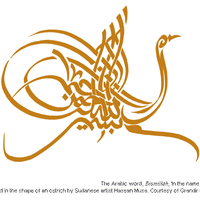
Bismillaah
Assalaamo alaykom all!I am new to this forum, but have been reading here regularly for months now, and this is my first post here.
Somehow I can understand TS confusion about the whole salah-issue here. Obviously salah is one of the important aspects in our deen, and none of us who read al-Quran denies that of course. The confusion sets in when everyone seems to have different ideas of what it means. Pray 2, 3, 4 or 5 times a day. Some even say there is no ritual/physical prayer at all. To each their own.
And it is this confusion that is causing me distress in my faith. Because I find myself unable to perform any salah. When I believed that there was one fixed way of doing it, I had no problems focusing and connecting in earnest with God. But now I'm unconvinced that my method is correct, and this inner dilemma is hindering me from performing prayer with the purity that I had before...
At the moment I am in a phase where I am not doing ritualistic prayer 3 times a day regularly. I feel confused in understanding what i am suppose to do in a prayer. I have tried to to do 2 sujood while saying some quranic verses but then the next day I become lazy due to confusion about timings and if Salah is also studying the quraan and "thanking" Allah and doing good deeds etc.
If you feel comfortable in praying the ?traditional way?, then why don?t you do that? Is there anything in al-Qur?aan that says you can?t pray that way? The only thing I can think of that might be akward ? some of you would probably say it?s completely wrong and shirk ? is some parts of the tashahud. But if that?s so, you can be quiet in that part, or praise God, ot make any du?aa you like.
I don?t understand what?s the big deal with praying the ?traditional way? if you belive salah = physical prayer. Well even if you think salah is something else, what?s wrong woth physical prayer as well? Is it so important to be different from ?the traditionalists? so we feel we must make up our own rituals when a person might feel comfortable with their way of praying? If you don?t feel comfortable with it, that that?s another question.
-
Salam Waqia,
you wrote about a Two very important issues
1- what's Wrong with traditional Salat ??? ( if real salat had to be physical, of course)
2 - is it so important to be " COMPLETLY " different from the traditionalists ??
i am sailing across this forum quite long ago, and still confused '(
Peace,
P.S Welcome to the forum welcome
-
Salam, all,
My way to perform SALAT is by reciting/reading the Great Reading.
What is the diffrence between my way and the "ritual prayer"
In the ritual prayer
- you start with Iqama--> non quranic
- when bowing or standing you pronounce the takbir--> non quranic
- at the end of fatiha you pronounce Amin--> non quranic
- during the ritual prayer you recite Quran--> this is quranic
Remember Allah gave words to Adam, The Great Reading are the Allah's words!
In my way all are quranic facts
- I start with "I seek protection in God against Satan the banished" before reciting the Great Reading as per 1698
- I start reading the Fatiha, the often repeated verses as per 1587
- then I start reading a chapter or more depending on the lenght, salat lenght is based on the following
Salat's duration is given in 1778 and 2187, this duration can vary depending on your geographical location, more you go to the north longer it is, in equator it is about 20 min.
For Nafila can be 1/3, 1/2, 2/3 of the night or what you can of it. - when making an "invocation/prayer" I finnish by "al hamdullilahi rabbi al alameen as per 1010
So what is common in the 2 ways --> reciting the Great Reading is the common denominator!
What does bowing, prostrating etc bring to the Salat?Peace
-
For those who Say That the Physical Traditional Salat/Prostration Ritual is Purely Physical and Mechanical, and therefore Meaningless.....
Would it be Incorrect for me to Bring up Sex as a Proper Analogy?
Is Sex just a Physical Ritual in which two people just Mechanically/Physically do repetitive Motions that mean absolutely Nothing In regards to Mentally, Emotionally and Spiritually?
For those of you who have had sex, is it Just Purely Physical? No emotions, No Mental Aspects, or Spiritual involvement?
If so I believe that would be very bland and not doing any justice. )
There is a Common Goal in Sex and a Mindset. The Person and Goal is constantly in your mind as you go through the Physical Motions. Chemicals Endorphins get released often intensifying the feeling of Passion and even Spirituality when Making love.
This is well documented as many feel that their "Souls Literally were in-tuned and vibrating together". There is much Energy in Making Love and From Observing the Dark Religions, It seems there is much Spirituality. This could be a Possible reason why Sex on Menstruation and Anal sex is forbidden. Not only for the Obvious Physical Medical hazards but for the Spiritual Repercussions that may arise from this.
Menstrual blood contains Dead Blood cells and Dead Eggs while Seaman contains rich/pure/living cells (sperm). Both Seaman, Menstrual blood, Urine, and fecal matter are often all used in the Dark Rituals such as Witchcraft for various reasons.
Now I know that these Dark Rituals are Non-Quranic and therefor categorized as Hearsay, But, it could very well be another reason why Menstrual Sex and Anal Sex is forbidden, along with Eating The Flesh of the Pig, (which also is refrained in Spiritual Religions due to its Spiritual Properties and Vibration levels).
So, The Point I am trying to make is This I think Obviously Sex is more than just a Physical Ritual, in the same way I think Prostration/Traditional-Salaat is more than just meaningless Physical gestures. I assume there is more to this then what the Eyes can see.
I am Not here to Refute Whether or not Ayman and Wakas is right or if THS is right. I am rather holding the belief that You should do what you feel is right and correct based on personal Experience and Interpretation of Quran.
The only thing I wish to Accomplish by this Post is to Reply to those who feel hole heartedly that Prostration/Traditional Salaat is purely Physical and therefore contains NO VALUE what so ever. I dont think this assertion is fair. Actually, I wouldn't say Anything is Purely Physical as all things contain various aspects to them.
Perhaps it is just the vale that the individual places towards it that makes it an efficient method.I cant speak for everyone, as we all have different methods, but for me...I personally feel the Symbolic Physical Prostration is the most efficient for me in achieving my goals of "Awareness, Shedding of the Ego, and Remembrance/Appreciation-gratitude/Adoration."
For you is yours and for me is mine, you will be questioned on yours and for me Mine.
Peace/Salaam
-
Salam Waqia,
you wrote about a Two very important issues
1- what's Wrong with traditional Salat ??? ( if real salat had to be physical, of course)
2 - is it so important to be " COMPLETLY " different from the traditionalists ??
i am sailing across this forum quite long ago, and still confused '(
Peace,
P.S Welcome to the forum welcome
Bismillaah,
Thank you for the welcoming!
Would you mind sharing your thoughts about these things?
Assalaamo alaykom
-
salam,
i pretty much agree with Brother Herbman's View of the subject. in fact, up to now, his understanding meets mine, but still there are some points to discuss ie. does "sujud" literally means prostration ? does "ruku3" literally means bowing ?
i'll never stop searching until i am very satisfied with what i'd find .
Salam ... -
salam,
i pretty much agree with Brother Herbman's View of the subject. in fact, up to now, his understanding meets mine, but still there are some points to discuss ie. does "sujud" literally means prostration ? does "ruku3" literally means bowing ?
i'll never stop searching until i am very satisfied with what i'd find .
Salam ...Salam,
for the sujud, please read
http//free-minds.org/forum/index.php?topic=9598240.0 and try the search engine, you will inchallah make your own conclusion on the subject.for "ruku3", I would like to ask you your thought, in arabic "ruku3" would mean "kneeling" and not "bowing" if I am not wrong?
Peace