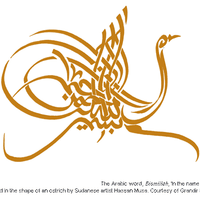
Who or What is Al-Muzzammil?
-
Dear all, do you see any resemblance with traditional beliefs?
Regards,
731
O you pay attention, one who is fallen behind due exaggerated sense of self pride.732
Stand up against the darkness until only a little is left.733
Judicious about it, until it is further greatly diminished out of that little left.734
If it increases and raises its head; its rebirth shall separate you again.735
For sure, we anticipate facing this would be an unpalatable saying for you.756
Truly, the stance against the darkness is very difficult to tread and to be able stand firm is an exception.757
Indeed for you it is like a long swim in the river. -
Peace ths,
ancient Arabic is as near to modern Arabic as original english, which was invented mostly in the 12th century (english), so in answer to your question, yes it is the ancient Arabic, but has little resemblance to the modern arabic. Two things were created to accelerate the transformation of Arabic, firstly most could not understand Arabic at the beginning so need translations, a book of grammar was constructed that corrupted the original rules of arabic grammar making the translations difficult to follow, then hadith was invented to divide and confuse further, and so after many centuries we have modern Arabic and ancient Arabic, and never the twain shall meet.
-
Peace ths,
ancient Arabic is as near to modern Arabic as original english, which was invented mostly in the 12th century (english), so in answer to your question, yes it is the ancient Arabic, but has little resemblance to the modern arabic. Two things were created to accelerate the transformation of Arabic, firstly most could not understand Arabic at the beginning so need translations, a book of grammar was constructed that corrupted the original rules of arabic grammar making the translations difficult to follow, then hadith was invented to divide and confuse further, and so after many centuries we have modern Arabic and ancient Arabic, and never the twain shall meet.
The difference is more distinct that people can imagine. If people knew the proper interpretation they would gasp.
Be safe
Amenuel -
Dear all, repeatedly questions are put forwards from several quarters. Who is the author of Quran? What is it origin? What is the jest of its theme or message? Is it new? Is it timeless? Is it relevant to current times? Isn't it obsolete now?
All above questions are important and pertinent. However, I maintain a position that I am not in a position to answer above questions. If I were to try it would be mere conjunctures and speculations. I want to desist from such an approach. I leave such approach to experts of religion and theology.
However, language based translation of Sura Al-Muzzammil comes very close to answering these questions. For consideration of all, here we present.
Regards,
731
A desire for you to pay attention, one who is fallen behind due to an exaggerated sense of self pride, egotism.
732
Stand up against the scarcity of intellectual enlightenment and willful ignorance until little is left.
733
Be reasoned about it, until it is further greatly diminished out of that little left.
734
If it increases and raises its head, dispose of it by gathering together, making it unmistakable.
735
For sure, we anticipate facing this would be an unpalatable axiom for you.
756
Truly, the march against the lack of intellectual enlightenment and willful ignorance is very difficult to tread, and to be able to stand firm against it is exceptional.
757
Indeed for you it is like a long swim mindful of intellectual enlightenment.
758
And preserve in the memory assurance conveying knowledge of your foundation (Rabb), and open yourself towards implementation in this direction.
759
The foundation for all perspectives, being not at all a deity for worship, except the totality is from whom you drive and deduce all knowledge.
7510
And be reasoned towards whatever others say and cut them off in pleasing manner.
7511
Alternatively you may abandon me for the habitual liars?, possessors of short-term advantage; although their time of prosperity is numbered.
7512
For sure in our potentiality are examples for self-control and tolerance.
7513
Which empowers over rage, indeed a relief of utmost quality.
7514
Anytime you face confusion about the natural disposition for virtue, be steadfast against it.
7515
Certainly, upon reasoning of the knowledge-based information, we let you have your own will. However, as soon as some were enabled of your own will, you turned rebellious and corrupt towards that information.
7516
Corrupted and consequently rebellious against this information; accordingly, we took it in our control for the prevention of disastrous consequences.
7517
If you hide the benevolent information in denial of all obligations then how would you guard against the time when your progeny shall become corrupt?
7518
The ideal substantive origins were created as a phenomenon with lasting promise.
7519
For sure this memorandum is for whoever desires an easy path towards his foundation (Rabb).
7520
For sure your foundation shall serve as signs, so that you shall be able to establish a relationship with exquisite writing in order to address the lack of intellectual enlightenment and willful ignorance; accordingly act rationally with it repeatedly, as a distinct community amongst all those living with you. The totality being not at all a deity for worship has determined the lack of intellectual enlightenment and ignorance as forbidden; knowing that you cannot deny it, accordingly, it returns to you. Therefore collect what is easy part by part through a collective effort, and put it together part by part. It is known that there shall be among you those whose constitution and temperament have changed, holding them behind causing violence in the planet earth. These are exceeding just limits in order to rival the eminence of the totality being not at all a deity for worship. Accordingly falling behind in getting to know thoroughly the easy path to the totality being not at all a deity for worship. Accordingly, collect together part to part what is easy, for from that then establish it, for the close following and pursuit of the correct course for prosperity. Furthermore, respond to the totality being not at all a deity for worship with love and affection, best of requital. Whatever good shall proceed from you, you shall find it with the totality being not at all a deity for worship; the possessor of virtue, the greatest reward. Therefore seek it as covering from the totality being not at all a deity for worship. For sure, the totality being not at all a deity for worship is a concealed source of eternal mercy.
-
ancient Arabic is as near to modern Arabic as original english, which was invented mostly in the 12th century (english), so in answer to your question, yes it is the ancient Arabic, but has little resemblance to the modern arabic. Two things were created to accelerate the transformation of Arabic, firstly most could not understand Arabic at the beginning so need translations, a book of grammar was constructed that corrupted the original rules of arabic grammar making the translations difficult to follow, then hadith was invented to divide and confuse further, and so after many centuries we have modern Arabic and ancient Arabic, and never the twain shall meet.
Abdun Nur, what you are saying is patently false, and I doubt you speak any Arabic to be making such far-fetching claims. Modern Standard Arabic is derived from Classical and Arabic grammar is derived from the Quran.
If this wasn't the case then no one would have the faintest idea of what the Quran is talking about, and comparing it to 12th century English is absurd.
-
Yes, that's because they ignore the Quran because they rely on "scholars" to tell them what to do. Not because they don't understand the Quran.
If you go and tell any Arab person who has been to secondary school the following, he will understand it clearly and without any hesitation whatsoever
The misguided behaviour comes from cognitive dissonance and following tradition blindly.
-
" Badar Bhai,I agree with the point raised by EH,a few weeks ago, that the translation is much longer than the actual sentence. This means that the English version of the ayas is not a literal translation,but an interpretation. Sultan."
Dear all above is a critique that was made. In any honest scientific work all critiques have to be taken seriously and responded with appropriate references. However, progress is only made if critique is accompanied with fact based analysis and references. I present my response as follows.
Regards,
731
A desire for you to pay attention, one who is fallen behind due to an exaggerated sense of self pride, egotism.
This combination of words in Arabic grammar terminology is called . Which simply is understood as a particle for raising attention.
Simply ?O you?.
However, paying close attention to the word makes it abundantly clear that it has three of the words of same class or meaning i.e., raising attention, , and .
There is no reason in the world to say ?O you? like traditional translation claims. Therefore, let us look up these as separate words.
is used to raise attention of everyone, irrespective of proximity to the caller ?all near and distant?.
Besides being used as it is also used in sense of meaning ?one who?.
is used to wake someone up from sleep.Keeping all the discussion above in mind the only fluent way to translate ?A desire for you all to pay attention?.
This is a combination of and which here is not used as a definite article (traditionalists who object to linguistic analyst of word Allah, where I contend that its is a contraction of ى have themselves translated here as (which I am glad they have as it strengthens support from current translation of Quran for can be contracted and used as ) it is followed by a verbal noun from 2nd form of root . The root meaning as ?He limped, by reason of pride or self-conceit, in his going.
So let us put together as literal translation,
?O you one who limped behind by reason of pride in moving.? Please compare, it with following.
?A desire for you all to pay attention, one who is fallen behind due to an exaggerated sense of self pride, egotism.?
Please decide for yourselves is later an interpretation or just a better translation. Therefore, for people not to keep complaining that English in not comprehensible. (All references will be made available upon request).
-
ancient Arabic is as near to modern Arabic as original english, which was invented mostly in the 12th century (english), so in answer to your question, yes it is the ancient Arabic, but has little resemblance to the modern arabic.
Salaam friend, I don't mean to contradict you, but your comparison is incorrect.
I can infer that by 'Ancient Arabic' you're referring to 'Classical Arabic' and by 'Original English' you're referring to 'Old English' - these are the standard terms used in linguistics in the English language.
Classical Arabic and Modern Standard Arabic aren't really that different. In general the only differences being that in MSA most of the case endings have gone, it has extra words for modern things, also complicated pronoun endings and moods are no longer used. The English language on the other hand has undergone drastic changes over the course of its existence to the point where it was debated whether English was actually a pidgin language.
Classical Arabic and the various Modern Spoken Arabic Languages are drastically different, but ultimately this is like comparing apples and oranges, because we're talking about the language of the Qur'aan which is formal and written vs. a form of spoken language which is living and dynamic. There are some (including myself) who believe that the Arabic the prophet and companions spoke was still different to that written down in the Qur'aan and there are very good reasons for believing this - but that is a discussion for another day!
-
"Salaam friend, I don't mean to contradict you, but your comparison is incorrect.
1.Classical Arabic and Modern Standard Arabic aren't really that different.
- Classical Arabic and the various Modern Spoken Arabic Languages are drastically different, but ultimately this is like comparing apples and oranges, because we're talking about the language of the Qur'aan which is formal and written vs. a form of spoken language which is living and dynamic. There are some (including myself) who believe that the Arabic the prophet and companions spoke was still different to that written down in the Qur'aan and there are very good reasons for believing this - but that is a discussion for another day! "
May be it is just me, but don't the statement 1 and 2 appear Oxymoron. Anyhow, predominant problem and difference between CA and MSA is lexical and not semantic or syntactic. Hence, no understanding of real Quran, as the lexical part of Grammar is what relates to concepts.
Regards,
-
May be it is just me, but don't the statement 1 and 2 appear Oxymoron.
There is one Modern Standard Arabic, there are many different Modern Spoken Arabic dialects that are evolving into languages so the statements aren't contradictory.
Anyhow, predominant problem and difference between CA and MSA is lexical and not semantic or syntactic. Hence, no understanding of real Quran, as the lexical part of Grammar is what relates to concepts.
Now THAT was an oxymoron! rotfl
So you're saying there is a lexical problem between CA and MSA and not a semantic one?
-
Now THAT was an oxymoron! rotfl
So you're saying there is a lexical problem between CA and MSA and not a semantic one?
You think it is an Oxymoron, because you only likey know use of word Semantics as meanings. Whereas, I consider it as term which realistically focuses on the relationship of signifiers, like words, phrases etc. Anyhow just a little technicality.
By Lexical, I meant the study of words and how meanings are assigned to these symbols. Just to get some idea, please share with us, what do you think the original lexical meaning was of Lexical root components of "Qaf-Ta-Lam", in CA?
Regards,
-
You think it is an Oxymoron, because you only likey know use of word Semantics as meanings. Whereas, I consider it as term which realistically focuses on the relationship of signifiers, like words, phrases etc. Anyhow just a little technicality.
By Lexical, I meant the study of words and how meanings are assigned to these symbols. Just to get some idea, please share with us, what do you think the original lexical meaning was of Lexical root components of "Qaf-Ta-Lam", in CA?
Regards,
! >
-
Peace Osman,
you believe modern Arabic and the Arabic of the Qur'an of 650 are identical, over 14 centuries nothing altered, all remain unchanged?
The rules of Arabic grammar which were compiled by great Arab scholars centuries ago, as well as renowned lexicons, also compiled centuries ago, were created in order to preserve the original meanings of the classical Arabic words.
These books were compiled out of fear by early Arab scholars, as the meanings and concepts were felt to be changing with the most rapid translocation, and translations of this great Book, out of the confines of the original text, in whose pure language it was revealed. Subsequently these books from the time of the Rasul were deposited, and protected in the custody of the great libraries across the Muslim world, and became hidden, decreasingly available for review in general, resulting in subsequent confusion and significant discrepancy in the understanding of the text of Al Qur'an, by the ensuing scholars.
Grammar in Arabic (, meaning "rules", underwent development in the late 700s. The earliest known Arabic grammarian is Abd Allah ibn Abi Isaq. The efforts of three proceeding generations of grammarians culminated in the book of the Persian scholar Sibawayhi.
Ab Bishr Amr ibn Uthmn ibn Qanbar Al-Bishr (akaSbawayh) (Sibuyeh in Persian, Sbawayh in Arabic, ه was a linguist of Persian origin born ca. 760 in the town of Bayza (ancient Nesayak) in the Fars province of Iran, died in Shiraz, also in the Fars, around 180 AH (796-797).
He was one of the earliest grammarians, and his work is now perceived as the authoritative reference, so the universally applied grammatical rules of the classical Arabic language, and his phonetic descriptions of Arabic are considered today the most precise ever made, leading some to compare him with Panini. He was greatly helped to spread his Persian grammatical version of the Arabic language in the Middle East, which has contaminated the entire world today.Sibawayh was the first non-Arab to write on Arabic grammar and therefore the first one to explain Arabic grammar from a non-Arab perspective. Much of the impetus for this work came from the desire for non-Arab Muslims to understand the Qur?an; the Qur'an, which is composed in a poetic language that even native Arabic speakers must study with great care in order to pronounce correctly, is even more difficult for those who, like Sibawayh, did not grow up speaking Arabic. Additionally, because Arabic does not necessarily mark all pronounced vowel sounds, it is possible to misread a text aloud. This ignorance of the Arabic language and the desire to pronounce the sounds with great precision, allowed the Persians to corrupt the rules of grammar and in so doing change the understanding of the written Arabic without changing the written or spoken Arabic itself.
After studying in Basra, Iraq, with a prominent grammarian, Sbawayh received recognition as a grammarian himself. Sbawayh is said to have left Iraq and retired to Shrz after losing a debate with Al-Farra a rival on Bedouin Arabic usage, although there are three variations of the same story, all three culminate in the same conclusion that Sibawayh is a great calamity in the correct understanding of the Classical Arabic language.
This calamity resulted in not easily understanding the guidance of the Qur?an, so began the desire for comprehension, a profuse amount of literature explaining historical events written centuries after they occurred, as well as proliferation of the books claiming to be the words of the Rasul (Messenger), which a reasoned mind knows comprises of pure unmitigated conjecture, poured forth.
This subtle alteration of grammatical rules would only impact upon translations, as it leaves the text itself unaltered, being established at the very infancy of the founding of the translations, it would also accelerate the mutation of the classical Arabic language, as outside pressures would increase with invented religious piety.
With the translations holding only the shadow of the message of the Qur?an it was no longer a crystal clear guide, people looked for clarity.
The birth of Hadith, polluted the world.
The first ever book compiled over a century after the Rasul?s life, had no more than about 150 of such defamations.
However, their number increased to hundreds of thousands, by the time another book of defamations was compiled, more than two centuries after Muhammad?s death.
These often dubious historical events and the defamations compiled later, subsequently became the main source of misunderstanding the verses of the Qur'an, naturally with a significant difference in confusions among the scholars.
The grammatical signs, including Gezm, fetha, kessra, dumma and multiple other signs used with the script which were put in painstakingly by the companions of the Rasul to preserve the words and the meanings to the best of their capabilities, are claimed to remain unchanged.
In addition to this, these rules of grammar, used by the script writers, and the original meanings of the words as understood by the companions and the Rasul were all preserved in the form of grammar books and lexicons by the scholars in that era.
These books were revisited by some scholars, but the most detailed work of translation of these preserved books was done by the western scholars, of which Edward William Lane was one of the greatest linguist of the Arabic language, who spent his lifetime translating these lexicons, with permission from the authorities who have the custody to the original work of the Muslim world.
With the explosion of the electronic media, and the advent of the internet, these books have now become available to all who wish to use them, to better understand the Qur'an and make an attempt to remove, not only the discrepancies in the established understandings, but also to make the Qur'an understandable purely on the basis of the language, without the help of Hadith or history books compiled much later.
-
Peace Osman,
you believe modern Arabic and the Arabic of the Qur'an of 650 are identical, over 14 centuries nothing altered, all remain unchanged?
Peace brother,
No I don't, on the contrary I listed the main differences between the two. My issue was with the idea that they are somehow DRASTICALLY different from one another akin to Old English and Modern English - this is a ridiculous claim that only an uninformed non-speaker of the language would make.
-
Thank you Osman for bringing some sense into this conversation...
Bkanwar and Abdun Nur
Please bring some examples of the changes between the original Quranic Arabic and our modern intepretation of this so that we can see exactly what you are talking about.
And no one constructed Arabic grammar books "out of fear". This is all conspiratorial nonsense. Were the first English grammar books and German grammar books written out of fear? Or were they just simply written so that people can understand grammar better?
Everything always has to be a conspiracy with you guys..