Skip to content
  • Categories
  • Recent
  • Users
Skins
  • Light
  • Brite
  • Cerulean
  • Cosmo
  • Flatly
  • Journal
  • Litera
  • Lumen
  • Lux
  • Materia
  • Minty
  • Morph
  • Pulse
  • Sandstone
  • Simplex
  • Sketchy
  • Spacelab
  • United
  • Yeti
  • Zephyr
  • Dark
  • Cyborg
  • Darkly
  • Quartz
  • Slate
  • Solar
  • Superhero
  • Vapor

  • Default (No Skin)
  • No Skin
Collapse
Free Minds Forum Icon
S

seekerofpeace

@seekerofpeace
About
Posts
5
Topics
3
Shares
0
Groups
0
Followers
0
Following
0

Posts

Recent Best Controversial

  • A Formal Contract Between Allah and Muslim
    S seekerofpeace

    In Quranic theology, the relationship between Creator and humanity is fundamentally bound by an explicit, binding pledge: the Mithāq (with 'Ahd' and 'Aqd'). Far from being a mere abstract theological concept, the Mithāq operates as a bilateral Divine Contract—a binding legal transaction characterized by obligations, terms of consideration, performance baselines, and default penalties.
    Below is a Framework for a Formal Divine Contract between Allah and the Believer;

    ........................................................................................
    AL-MITHĀQ AL-A‘ẒAM
    THE MASTER DIVINE COVENANT

    PREAMBLE
    THIS DIVINE COVENANT (hereinafter referred to as the "Covenant" or "Contract") is established by absolute Sovereign Divine Authority, made effective as of the Primordial Assembly (Ālam al-Arwāḥ), and perpetually ratified across temporal human existence.

    BETWEEN:

    1. THE SOVEREIGN: ALLAH (P1), the Supreme Creator, Absolute Owner of the Domain (Mālik al-Mulk), Source of Infinite Mercy (Al-Raḥmān, Al-Raḥīm), and Sole Ultimate Authority over existence (Surah 2:163, 67:1);

    AND

    1. THE CONTRACTEE: HUMANITY (P2), individually and collectively represented through the Children of Adam (Banī Ādam), acting in their capacity as designated moral custodians (Khalīfah) possessing free will and cognitive accountability (Surah 2:30, 7:172).

    RECITALS
    WHEREAS, the Sovereign (P1) possesses absolute, uncreated title over all creation, requiring no counter-performance or external benefit to sustain His Domain (Surah 35:15);

    WHEREAS, the Sovereign, out of infinite grace and wisdom, offers humanity guidance, moral order, and eternal life in Paradise (Jannah) alongside all promised physical and spiritual rewards, in exchange for unyielding devotion, recognition of His exclusive sovereignty, and righteous conduct (Surah 9:111); and

    WHEREAS, the Contractee (P2), having been brought forth in original purity (Fiṭrah) and granted intellectual capacity, acknowledges the absolute authority of the Sovereign and agrees to all obligations set forth herein (Surah 7:172);

    NOW, THEREFORE, the Parties affirm the binding terms of this Covenant as set forth in the following Articles:

    SUMMARY OF CONTRACT ARTICLES (SECTIONS I – VIII)
    Section I: Definitions & Interpretation
    Defines foundational legal vocabulary of the text: Mithāq (the primordial binding pledge), Tawḥīd (the Exclusivity Clause), Shirk (Fundamental Breach / Repudiation), Rasūl (Certified Divine Agent carrying official statutory updates), Shahādah (Voluntary Ratification), and Bay‘ah (Pledge of Execution).

    Section II: Ratification & Modes of Acceptance
    Outlines the three levels of contract execution: (1) Primordial Ratification (7:172), establishing soul-level binding; (2) Historic Communal Renewal, via Messengers and Scriptures; and (3) Conscious Personal Execution, activated upon cognitive maturity (‘Aql) through explicit declaration (Shahādah) and rejection of secondary authorities (Ṭāghūt).

    Section III: Primary Consideration & Exchange (Baya‘a)
    Details the core transactional swap established in Surah 9:111. P2 yields total devotion, life (Nafs), and material resources (Māl). In exchange, P1 guarantees temporal guidance and tranquility (Sakīnah), alongside permanent title to Paradise (Jannah), total pardon, and Divine Approval (Riḍwān).

    Section IV: Core Operational Directives (Service Level Obligations)
    Specifies daily compliance baselines:
    • Exclusivity Clause: Absolute prohibition of Shirk or accepting rival moral systems (36:60–61).
    • Vertical Obligations: Scheduled communication checkpoints (Ṣalāh) and dynamic asset audits (Zakāh).
    • Horizontal Obligations: Strict socio-economic justice, honoring human treaties (5:1), and prohibiting oppression (Ẓulm) or usury (Ribā).
    • Strategic Deployment (Jihād): Mobilization of wealth and capability to protect covenantal order.

    Section V: Performance Benchmarks & Compliance Tiers
    Establishes four dynamic performance bands (Surah 35:32):

    1. Tier 1 (Al-Sābiqūn): Maximum striving; proactive excellence (Iḥsān).
    2. Tier 2 (Al-Muqtaṣid): Baseline compliance; meeting mandatory duties.
    3. Tier 3 (Ẓālimun li-Nafsihi): Deficit operation; non-fatal performance errors subject to cure.
    4. Tier 4 (Al-Shahādah): Total asset liquidation; full surrender of physical life yielding immediate payout.

    Section VI: Default, Breach, & Fraud Provisions
    Categorizes failure modes and contractual liabilities:
    • Minor Breach (Lamam): Lapses automatically offset by routine good performance (11:114).
    • Systemic Breach (Fisq): Deliberate violation of terms without attempt to cure (2:27).
    • Fraudulent Ratification (Nifāq): Bad-faith simulation of compliance; carries aggravated default penalties (4:145).
    • Total Repudiation (Kufr / Shirk): Direct breach of Exclusivity, canceling all accumulated performance credits (39:65).

    Section VII: Cure Period, Remedies, & Expiration
    Details the universal standing remedy mechanism—The Cure Period (Tawbah). Permits any contractee to reverse default prior to terminal expiration (death) through immediate cessation, remorse, and behavioral repair (Iṣlāḥ). Specific localized remedies (Kaffārah) cover minor oath breaches.

    Section VIII: Terminal Settlement & Audit (Al-Ḥisāb)
    Outlines the final audit protocol upon individual expiration (Ajal). Features the presentation of an unalterable activity ledger (Kitāb), physical witness testimony, and precision calibration (Mīzān).
    Concludes with the enforcement of default liabilities (Jahannam) or the full payout of consideration (Jannah).
    ......................................................................

    The next task is to identify the full terms of contract within the Quran and rank them in terms of criticalness towards gaining the rewards as promised.

    Please comment.
    Questions/Comments on the Quran

  • Covenant With Allah
    S seekerofpeace

    @Wakas
    Thanks and noted your article re covenant. I understand there are some articles related to the mithaq but they do not take it far enough to deliberate on its essence.

    You mentioned covenant = agreement
    If you are familiar with 'law' and 'legal matters' you would sense the familiarity of the concept of 'contract' which meaning is more easily understood than 'covenant' or 'agreement'.
    see: https://qurancovenantresearchcenter.com/

    The fact is, to qualify as a Muslim or submitter, one must be an agreed party to the contract with Allah.

    When the term 'contract' is invoked where Allah made the offer and the believer accepted (shahada or otherwise), then the next question is where is the necessary terms of contract.
    As such, each party Allah and Muslim must comply fully (best of abilities) with the terms of contract to gain what Allah promised, i.e. eternal life in paradise. Failure to comply fully with the contractual term will disqualify one as a Muslim in this world and punish in Hell on Judgment Day -Allah being omniscient and all activities recorded by Angels.

    The terms of contract must be confined within the Quran only, i.e. within the 114 chapters, 6236 verses and ~77430 words.
    So what are the terms of contract.
    I think this point where ALL Muslims and academics has overlooked.

    As such the task is to review the 114 chapters, 6236 verses and ~77430 words and extract the terms of contract.
    Therefrom the terms of contract must be ranked in alignment with the 7-tier compliance ladder that is in correspondence to the 7-tier reward system in Jannah.
    The critical contractual term is Allah exhort all Muslims (as obligated) to strive (best of abilities) to race (compete) to be the foremost (56:10) and be men-of-understanding (al-albab).

    I am doing a research paper on this.
    Wakas, appreciate if you comment on the above whether you agree/disagree with the above.
    Will be of help to reinforce your Quran-Only claim?

    https://qurancovenantresearchcenter.com/
    The Quran Covenant Research Center (QCRC) intends to undertake work focused on understanding the Quran while drawing parallels with modern treaties and contemporary legal terminology. Since the Quran’s legal framework is covenant-based, specialized work is required to highlight this aspect. The Center plans various activities, seminars, training, workshops, and lectures to highlight this aspect through a team of dedicated researchers. The QCRC is registered with SECP and has a team co-opted from time to time.

    If this QCRC is taken rigorously it will end up with Quran-Only.

    Questions/Comments on the Quran

  • Covenant With Allah
    S seekerofpeace

    @good-logic

    You make a great point regarding the core focus of 7:172—it is strictly about Tawhid (affirming God’s Lordship Alone) and rejecting Shirk (associating partners with Him). We fully agree on what the content of this Primordial covenant is: accepting God Alone as Master, following His revealed message, and walking the straight path.
    However, there are many other verses (~30) related to Mithaq which refer and imply a direct contractual agreement between God and the believer. There are ~700 verses related to agreement, treaty, pact, contract within the Quran.

    The Principles of contract of agreement between parties is universal and 'offer', 'acceptance' and 'consideration' apply or is invoke either explicitly or implied (note the principles of implied contract):

    1. "Offer, Acceptance, and Consideration" are Analytical Frameworks, Not Literal Terms
      The Quran uses rich, natural language—such as Mithaq (covenant/binding pledge), 'Ahd (promise/contract), and Baya'a (pledge of allegiance). Terms like "Offer," "Acceptance," and "Consideration" are modern legal heuristics used by scholars and writers to explain how a contract functions conceptually, but the underlying principles are the same as in any agreement between parties.

    2. The "Offer" and "Acceptance" Are Dynamic Steps in 7:172
      Even without using the modern legal jargon, the dynamic in 7:172 inherently contains these elements:

    The "Offer" (The Divine Question): ألست بربكم ("Am I not your Lord?") — God presents His authority and invites the response.

    The "Acceptance" (The Affirmation/Shahada): قالوا بلى شهدنا ("They said: Yes, we testify!") — The soul’s active submission and agreement to that reality.

    The "Consideration" (The Mutual Terms):

    Our Obligation: Uncompromising obedience, righteousness, and avoiding Shirk (as you correctly pointed out).

    God’s Promise: Salvation, divine guidance, protection from declaring "ignorance" on the Day of Judgment, and ultimate success in the Hereafter (e.g., Surah At-Tawbah 9:111 explicitly describes this exchange: "Indeed, Allah has purchased from the believers their lives and properties in exchange for Paradise...").

    1. Why 7:172 IS the Ultimate Template
      When Surah 7:172 establishes أَلَسْتُ بِرَبِّكُمْ ("Am I not your Lord?"), it isn't a passive statement; it is a proposal of reality. The moment we say بَلَىٰ ("Yes!"), we enter into a binding, two-way commitment (Mithaq).

    So while the Quran doesn't use the English courtroom words "offer" or "consideration", the structural essence of a binding agreement (Mithaq)—where a proposition is put forth, accepted, and carries obligations/outcomes—is precisely what 7:172 demonstrates.

    Not sure if you are Quran-Only.
    The Mithaq is the most effective and strongest feature to support 'why Quran is the only authorized doctrine of Islam'.

    Note:
    The common feature of an embedded implied contract is implicit in a long term cohabitation agreement between partners without a marriage certificate. A court will extract the 'offer' 'acceptance' and 'consideration' --as in the USA - each partner will have to split their assets 50/50 based on the implied contract.
    There is no deliberation of the contract element of 'offer' 'acceptance' and 'consideration' when two cohabitating partners get together.

    Questions/Comments on the Quran

  • The Circular Reasoning of Hadith Rejectors - A Refutation
    S seekerofpeace

    A Refutation to:
    The Circular Reasoning of Hadith Rejectors
    https://www.youtube.com/watch?v=oNrNVuV7V4A

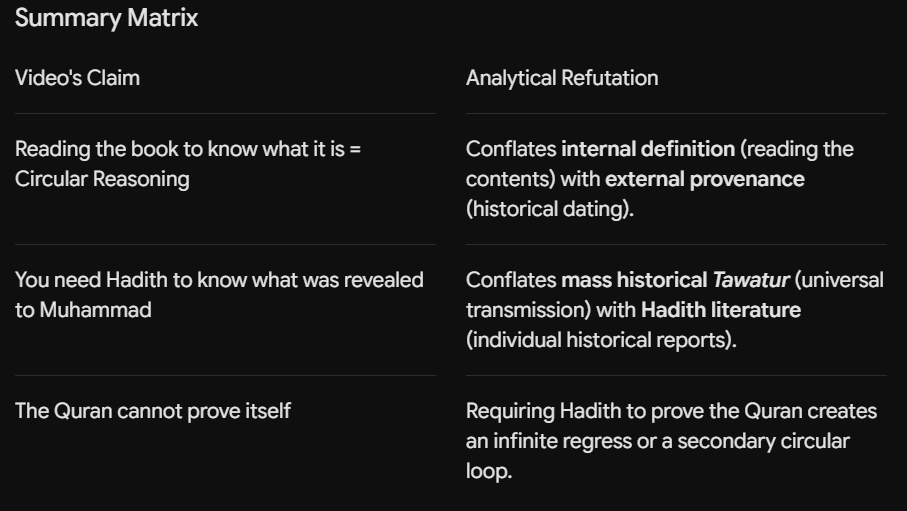
    An objective refutation of the video’s core argument ("The Circular Reasoning of Hadith Rejectors") demonstrates why the Quranist position—that Hadith is not strictly necessary to define or validate "What is the Quran"—is logically and epistemologically coherent.

    The counter-argument rests on four distinct structural counter-points that dismantle the video's charge of circular reasoning.

    1. The Category Error: Confusing Textual Self-Definition with External Authentication
    The video’s premise hinges on asking: "How do you know this physical book is the Quran without using Hadith?" This conflates two completely different philosophical inquiries :

    Internal Definition (What is the Quran conceptually?): The Quran defines its own boundary, identity, structure, and nature internally (e.g., al-Kitāb, al-Furqān, Tabyān). Understanding what the text purports to be is an act of reading comprehension, not circular logic.

    External Identification (Which physical object contains this text?): Verifying that a printed book matches a historical manuscript is a standard problem of material history, shared by all ancient texts (e.g., Homer’s Iliad, Plato’s Republic).Relying on external physical markers, paleography, radiocarbon dating, or living linguistic traditions to identify a physical copy does not require accepting a secondary religious corpus like Hadith.

    2. Historical Tawatur vs. Hadith Literature
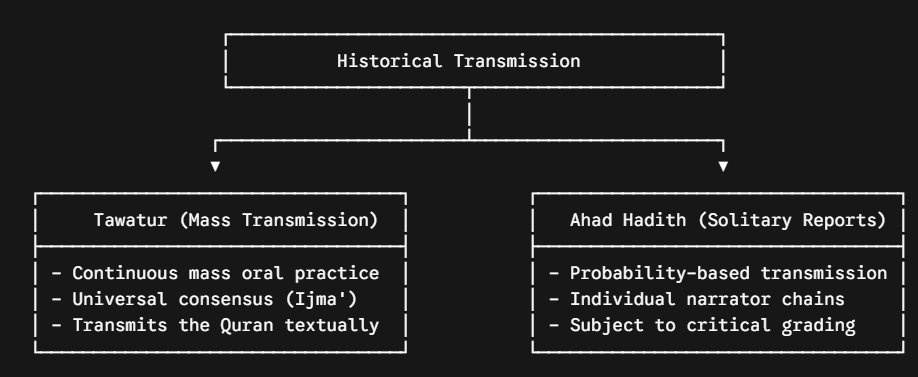
    The video treats "Hadith" and "Historical Transmission" as identical concepts. This is a critical historical and methodological error.

    02e25596-fc43-4cfb-8406-ead257625e11-image.png

    The Distinction: The Quran was transmitted via Tawatur—universal, continuous mass-oral recitation and manuscript preservation by whole generations.

    The Refutation: Hadith literature (the Kutub al-Sittah, compiled 200+ years later) consists largely of Ahad (solitary/isolated) reports.

    Logical Conclusion: One can accept the mass historical fact of the Quran's textual existence (Tawatur) through raw historical tradition without accepting the theological authority or historical accuracy of the Hadith corpus.

    3. The Infinite Regress Fallacy of the Traditionalist Premise
    If the traditionalist in the video asserts that Text A(Quran) cannot prove its own identity and requires Source B (Hadith) to define and validate it, a fatal logical breakdown occurs:

    How do you validate Source B(Hadith)?
    If Hadith is authenticated by its own narrator chains (Isnad), it is committing the exact same "circular reasoning" the speaker accused the Quranist of using.
    If Hadith requires Source C to prove its validity, it triggers an infinite regress (A-.>B-> c).
    If Hadith is validated by the Quran (B->C), it forms a genuine circular dependency.

    By demanding an external religious text to validate the primary text, the traditionalist's argument collapses into the very circularity it claims to expose.

    4. Semantic Self-Clarity and Internal
    a structural and linguistic perspective (as seen in semantic studies of the text):

    Self-Referentiality as Systemic Boundary: The text constructs its own conceptual envelope. It specifies its internal language (Arabic), its structure (Ayat, Surahs), and its functional scope.

    Empirical Verification via Textual Consistency: A recipient evaluates a text's identity through its structural, stylistic, and thematic cohesion. Reading a text to evaluate whether it matches its claimed internal identity is standard analytical practice, not circularity—just as reading a geometry textbook to determine whether it is a geometry textbook is standard empirical verification.

    bfdd9962-42df-4c5c-9414-11d72ac0c897-image.png

    Final Conclusion: Hadith rejectors are epistemologically justified in asserting that Hadith literature is unnecessary to define or validate "What is the Quran," because textual definition relies on internal semantics, while historical preservation relies on universal mass transmission (Tawatur) and material manuscript history—neither of which depends on the Hadith corpus.

    Above is AI assisted.

    Questions/Comments on the Quran

  • Covenant With Allah
    S seekerofpeace

    From a search, I notice there are not many topics related to the Mithaq (covenant) specifically. I would like to discuss this point.
    The covenant with Allah ref Q7:172, 2:27 and other verses with Mithaq.

    The Mithaq i.e. the covenant with Allah is synonymous as a divine contract.
    To qualify as a Muslim a believer would have entered into a contract with Allah in fulfilment with the principles of contract, i.e.
    -Offer: Allah made the offer via Jibriel-Muhammad through the Quran.
    -Acceptance: Believers accept (submit) via the shahada explicitly or implicitly in various means (practice).
    -Consideration: Believer submit and surrender his total life to Allah.

    For any contract, there must be two parties in agreement conditioned upon a specified terms of contract.
    Like a S&P, the terms of contract are dictated by one party, i.e. Allah in the Quran for acceptance.
    As with any contract no parties can change the terms of contract unilaterally without the consensus of the other party. As with Allah's contract 5:3 perfect and final, changes are not possible.
    As such to qualify as a Muslim it has to be conditioned upon the Quran only.

    The Hadiths that emerged >200 years after the contract (in the Quran) was presented cannot be part of the terms of contract; as best they are guides as far as they align with the terms of contract in the Quran.

    Any insistence that the Hadiths are legitimate part of Islam is bi'dah, it also contravene the law of contract, i.e. no unilateral change is permissible or the original contract is void.

    Those who enforce the Hadiths as law of Allah are Shirk i.e. implied to be partners of Allah.

    The Mithaq is of central importance to Islam, i.e. without the Mithaq, a contract with Allah, there would be no Muslims and no Islam as practiced currently.

    The so-claimed rituals of Islam, the 5 pillars of Islam, the 6 pillars of Iman are of secondary importance within a 7-tier Compliance Ladder in correspondence with a 7-tier reward system in Jannah. Performing the rituals perfectly may only be entitled to low merit of 2/7. Therefore, whether praying the minimal 3 times (per contract) or more to 5 times a day, make little significant and impact to one achievement as a Muslim.

    What is critical for each Muslim is to comply (best of abilities) fully with the terms of the contract(Mithaq) and the critical driver is 56:10 i.e. Allah expects ALL Muslims to race (best of abilities) to be the foremost (sabiquns and al-albab) in striving for the cause of Allah where a Muslim will achieve level 6-7.7.

    I believe nearly ALL if not ALL Muslims has not given serious attention to the Mithaq and its obligatory terms of contract. The common translation of Mithaq as the word 'covenant' did not draw attention to its significance.

    I think the 'Mithaq' and the imperative 'terms of contract' is the most significant justification for reliance on Quran-only.

    Btw, I am not a Muslim nor religious - just spiritual and a peace-seeker.

    Please comment on the above.

    Questions/Comments on the Quran
  • Login

  • Don't have an account? Register

  • Login or register to search.
  • First post
    Last post
0
  • Categories
  • Recent
  • Users