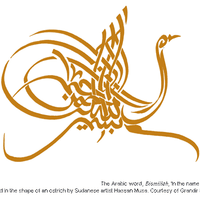
Harmony be with you Seeking,
I find it a little sad that instead of just 'agreeing to disagree' people create sects. I mean, everyone will have different views and see things differently, but it's like they refuse to accept that idea, and instead insist that only they can be correct. All it does is cause division and fighting....
A problem is that it is the conjecture that the sects are fighting over and not the essential stuff. The rituals and rites that they usually have (despite "God" being a non-object entity with no person characteristics) is just that thing they may even kill over in some cases. But it is mainly that "looking down on others" which is the saddest thing of them all regarding the dogmatism and zealotry. In the mainstream translation of Qur'an a "believer" is told to kill a polytheist unless they perform the ritual called 'salat(eh)'. Those who advocate that 'salat(eh)' means ritualistic prayer has this and many other literal qualitative issues to deal with.
I just had a mental image of a pig eating a cadaver.... -X
I do like the idea of eating just herbivorous animals though-I normally prefer beef and chicken to pork anyway, though I need to be a bit more careful in Japan-seriously, if the food doesn't contain seafood, it contains pork. /
Personally I find that the old 'Torat(eh)' which has its revelation with Moses was distorted and that the text is supposed to say that consumed meat should be from herbivores. Swines eat just about anything making them omnivores, and the animal is surprisingly similar to humans to the extent that their DNA is very identical to humans, and humans are also omnivores. Swines do not digest grass like cows or sheep either, right?
In the Biblical scriptures in the so-called Gospels/Injeel, Jesus allegedly moves several evil spirits from a man and puts those in some swines and then commands them to run off a cliff. I am not sure of the truthfulness in that one, but if it is a hint then it is quite sharp. The population in the town/village nearby got very mad at Jesus it seems due to this and told him to leave which he did.
However, I find that all of "God"'s "laws" are logical and rational and there is none of them which are just a test of faith but they are there because they are good for us. I have seen some research studies on the meat of swine which seem to point at the fact that this meat is rather poor quality to eat for humans.
I think I recognise one Arabic letter in that! (Sorry, I've been looking up how to learn Arabic and although I can't write or say anything yet, I think I can recognise one or two letters. I get excited when I recognise things in foreign languages, forgive my enthusiasm ) )
Download a chart over all Arabic letters with their phonetic text on it and learn to identify and pronounce them. This you can do without a teacher. I learned them this way when I have been studying Farsi (since my wife is an Iranian). I think it is only the letters (qhaaf) and (ghain) that "Westerners" will have a problem with initially. You may get an irritated throat in the beginning. (ain) has a slightly spectacular pronunciation also, for Arabs/Persians pronounce it a bit like 'ae', Ali is a name with it.
From the literal translation, it seems like less 'forbidden' and more like 'do what is right/pristine/pure.' It seems a lot less 'scary' when seen from the literal translation, and more like advise to avoid it for one's own good.
Yes. That is at least from what I have been investigating upon so far. My understanding does not fit with where 'haram' occurs in a mainstream translation and I am working on this. From the current interpretation ability it seems 'Al-Masjed Al-Haraam' is actually referring to the upholding of the commandments. What I actually have concluded is that it does not refer to a building whatsoever.
By a second thought on the literal translation I gave you, one can say it means advisable/recommended for you. None of "God"'s "encouragements" are dogmatically applied on man and it is free to follow, but by adhering to them you improve the possibility to grow spiritually which is a must to leave the flesh behind (as Jesus put it) and doing so is the point which man has to work on. I find that people to indulge in various rituals and stuff miss certain points on their character.
I know you do not know Arabic at all, but there is something fishy about the standard translation while I checked 2173 in the terms of interpretation. It says
Anema haram aelaikum
It seems that there is a negative particle before the 'haram' word which indicate that it means "Be One Thereof Not - Good Concrete/foundation/pristine - "on/for you"... bla bla. I have been studying the Arabic independently of traditional Arabic grammar and I have not yet made out which is a negative particle and which is, 100%. I know that depending on the structure 'LA' and indicate a negative, but traditional interpreters interpret this wildly with sometimes negative and sometimes not. Such as in 2173 it ought to be possible that it starts negatively.
If we separate the letters, AN = It is, MA = Not, HARAM = "Goodly/recommended". Nun in AN refers to entity while 'alef' as I think I said means the state of "being", it is quite logical that in a phrase like this alef + nun stands for "It is". My problem is with MA, it points towards a negative mood. Anyway, as to the structure of "HARAM" it does not support something "forbidden", so the phrase needs to mean something else like I suggested. Nowhere is ha (used in HAram) used in a negative regard (except perhaps in other misinterpretations). It is used in Hakm which can be said means 'wisdom' and Rahman which traditionally is interpreted as 'Gracious' while I interpret literally "Foundation Good Thereof One", and Halal which you already know. There are more, but those sprang to mind right now.
MA seems to have a negative meaning like 'not'. It may be that the combination of meem + alef causes a negative form of the usual "Thereof" which I translate 'meem' as. 'meem' also seem to need a reference which is not given in a word which would end with alef. For example, MIN (from) has a reference, it refers to 'entity'. AN occurs frequently in the Arabic discourse and it literally means "Be One/Entity", although I would reverse the order and say "It is". If the text would advocate that it was a negative meaning with "haram" then it would say AN HARAM AELAIKUM. I am going to study "MA" more in detail from now on. Ironically it is very similar referencing as in "AMEN/IMAN" which means "Be Thereof ONE/ENTITY", marking that an entity definitely is from.
Arabic is a very logical language once one gets the hang of it. The grammar is built around logic to the letter. And "God" left hints in the scripture, the so-called 'initials' (which begin many chapters) seem to been left there for a purpose of "correcting" what has been distorted by someone who is able to understand them. It was 'saad' and 'nun' which begin chapter 38 and 68 respectively that got my suspicious over their meaning. In those you have the 'initial' letter and then it followed by the conjunction 'wa' (and), and it would be lame if not the lonely letter would carry a certain meaning because you rarely begin a narrative, particularly not a new chapter, with "and".
I do not trust traditional interpreters at all nor dictionaries, and I think this is a wise stance. I also think that over history men have tried to interpret it with uncertainty and inferred a lot and sadly failed. It also shows that they tried their hardest at extracting rituals and other typical Pagan activities from the discourse. I have suspicions "tainted" 'Jews' had their hands on it and transferred their Pagan-influenced practices. They had already forcefully made the "Mosaic Law" as strict commandments (without heart) and more or less distorted everything the prophets ever said.
You have the example of Masjed Haram, I can give you an example of a passage with it and you can judge yourself
2144 We see the shifting of your face towards the heaven; We will thus set for you a precept (qiblah/focal point is used here) that will be pleasing to you ?You shall set yourself towards respect of the goodly (Al-Masjed Al-Haraam is used here); and wherever you may be, you shall all set yourselves towards it.? Those who have been given the decree know it is the truth from their Lord. And God is not unaware of what you do.
Suddenly there is no Pagan statue in the form of a house in a city called Mecca anymore.
2149 And from wherever you go out, you shall set yourself towards respect of the goodly (sujud could also mean "serve" since it implies on "submissive", perhaps "goodly works" may be viable or GOOD ATTITUDE?) ; it is the truth from your Lord; and God is not unaware of what you do.
97 How can the sectarians (my current interpretation of mushrik) have a pledge with God and with His messenger? Except for those with whom you made a pledge near the Restricted Temple regarding the "goodly works" as long as they are upright with you, then you are upright with them. God loves the righteous.
I will not give more examples here, but it is quite farfetched to find a house in the desert in the Arabic discourse. You have to falsely abuse words to induce that meaning. It is as farfetched as that "God" would enjoin people to perform a physical Pagan ritual. That is from men themselves.
Thank you for the advice! You always give me information to think about more and to help me understand more. )
You are welcome.
Have faith